
Why Many Institutional Investors Keep Gold in Their Portfolios: The Strategy Behind Smart Money in 2026
July 20, 2026 · GoldPriceNow · 6 min read
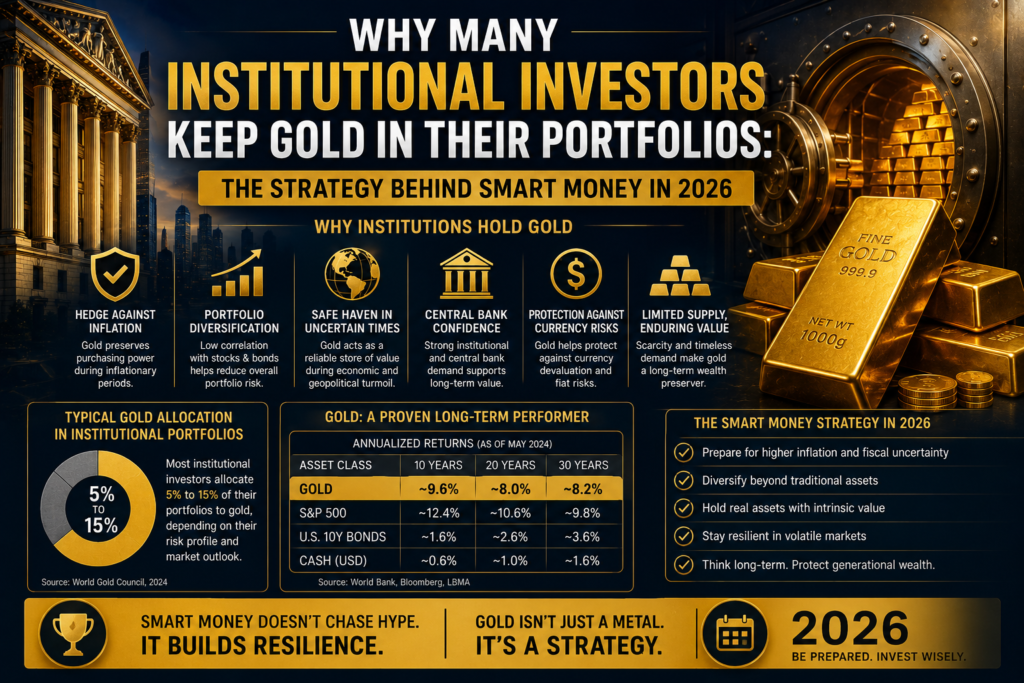
Why Many Institutional Investors Keep Gold in Their Portfolios: The Strategy Behind Smart Money in 2026
When markets are soaring, headlines often focus on technology stocks, artificial intelligence, and cryptocurrencies. Yet behind the scenes, many institutional investors continue to maintain allocations to gold. From central banks and pension funds to hedge funds and family offices, gold remains a strategic asset—not because it guarantees profits, but because it can help manage risk within diversified portfolios.
In 2026, gold continues to attract attention as investors navigate inflation, changing interest-rate expectations, geopolitical uncertainty, and currency fluctuations. The key question isn’t whether institutions expect gold to outperform every other asset, but why they continue to hold it even when other markets are strong.
Why Institutions View Gold Differently
Professional investors typically focus on risk-adjusted returns, not simply chasing the highest-performing asset.
Gold is often held because it may:
- Diversify portfolios.
- Reduce overall volatility.
- Act as a store of value during uncertain periods.
- Provide liquidity during market stress.
- Balance exposure to stocks and bonds.
Rather than replacing growth investments, gold is frequently used alongside them.
Who Invests in Gold?
Gold ownership extends far beyond individual investors.
Central Banks
Central banks hold thousands of tonnes of gold as part of their foreign exchange reserves. Gold is viewed as a reserve asset that is independent of any single country’s currency.
Pension Funds
Large pension funds often seek long-term stability. Gold can complement equities and bonds within diversified portfolios.
Hedge Funds
Some hedge funds increase gold exposure when they anticipate higher volatility, inflation, or macroeconomic uncertainty.
Family Offices
Many wealthy families include gold as part of long-term wealth preservation strategies spanning multiple generations.
Why Gold Remains Important in 2026
1. Portfolio Diversification
Diversification is one of the strongest arguments for owning gold.
Rather than relying entirely on one asset class, institutions spread investments across:
- Equities
- Bonds
- Commodities
- Real estate
- Cash
- Gold
This approach can help reduce overall portfolio risk because different asset classes may respond differently to economic conditions.
2. Inflation Protection
Inflation reduces purchasing power over time.
Although gold does not always move directly with inflation, many investors consider it a useful long-term hedge when inflation expectations rise.
3. Geopolitical Uncertainty
Wars, trade disputes, sanctions, and political instability often increase investor demand for assets perceived as defensive.
Gold has historically attracted attention during periods of elevated uncertainty, although its price can still fluctuate.
4. Currency Diversification
Because gold is priced globally and is not tied to one nation’s monetary policy, institutions often use it to diversify away from concentrated currency exposure.
Gold vs Other Major Assets
| Asset | Growth Potential | Volatility | Income | Diversification |
|---|---|---|---|---|
| Stocks | High | High | Dividends (some) | Moderate |
| Bonds | Moderate | Low-Moderate | Interest | Moderate |
| Gold | Moderate | Moderate | None | High |
| Real Estate | Moderate | Moderate | Rental Income | Moderate |
| Cash | Low | Very Low | Low | Low |
Gold differs because its primary role is often portfolio diversification rather than income generation.
Central Bank Buying Continues
One of the strongest long-term signals supporting gold is continued central bank demand.
Many central banks have increased their gold reserves in recent years as part of reserve diversification strategies. While buying levels vary over time, institutional demand has remained an important component of the global gold market.
Why Institutions Don’t Put Everything Into Gold
Contrary to popular belief, professional investors rarely make all-or-nothing bets.
Instead, many institutions maintain balanced portfolios that include:
- Stocks for long-term growth.
- Bonds for income and stability.
- Gold for diversification.
- Cash for liquidity.
- Alternative investments for additional return opportunities.
Gold typically represents one part of an overall investment strategy rather than the entire portfolio.
What Risks Do Institutions Consider?
Professional investors also recognize gold’s limitations.
Gold Doesn’t Produce Income
Unlike dividend-paying stocks or interest-bearing bonds, gold does not generate cash flow.
Price Volatility
Although often considered defensive, gold prices can experience significant short-term fluctuations.
Opportunity Cost
During strong equity bull markets, stocks may outperform gold for extended periods.
These factors explain why institutions usually combine gold with other assets instead of relying on it exclusively.
Is Gold Still Relevant in the AI Era?
Artificial intelligence, cloud computing, and technology stocks have reshaped financial markets.
Yet institutional investors continue to allocate to gold because portfolio management is not about predicting a single winner. It is about preparing for multiple economic scenarios.
Technology may drive growth, while gold may contribute to resilience during periods of market stress.
What Individual Investors Can Learn
Retail investors don’t necessarily need to copy institutional portfolios exactly, but several principles remain valuable:
- Diversification often matters more than chasing recent winners.
- Risk management is as important as return potential.
- Long-term investing generally benefits from disciplined allocation rather than emotional decisions.
- Asset allocation should reflect personal goals, time horizon, and risk tolerance.
Final Thoughts
Gold remains a significant component of many institutional portfolios—not because it guarantees superior returns, but because it can play a valuable role in diversification and risk management.
In 2026, as markets continue to respond to inflation, interest-rate expectations, geopolitical developments, and economic uncertainty, many professional investors continue to view gold as one piece of a balanced investment strategy.
For individual investors, the most important lesson may not be to choose between gold and stocks, but to understand how different assets can work together over the long term.
Key Highlights
- 🏦 Central banks, pension funds, hedge funds, and family offices continue to hold gold.
- 🌍 Gold is widely used for diversification and portfolio risk management.
- 📈 Professional investors generally combine gold with stocks and bonds rather than replacing them.
- 💰 Gold does not produce income but can serve as a store of value and diversification tool.
- ⚖️ Successful long-term investing often focuses on balanced portfolios instead of concentrating in a single asset.
FAQs
Why do institutional investors own gold?
Many institutions use gold to diversify portfolios, manage risk, and complement investments in stocks and bonds.
Do central banks still buy gold?
Many central banks continue to hold and periodically add to gold reserves as part of long-term reserve management strategies.
Is gold better than stocks?
Gold and stocks serve different purposes. Stocks aim for long-term capital growth, while gold is often used for diversification and wealth preservation.
How much gold do professional investors typically hold?
Allocations vary widely depending on investment objectives, market conditions, and risk tolerance. There is no universal percentage suitable for every portfolio.
Is gold a good investment for beginners?
Gold may be appropriate as part of a diversified investment strategy, but the right allocation depends on individual financial goals and circumstances.
About GoldPriceNow
GoldPriceNow delivers trusted coverage of gold prices, silver rates, precious metals news, investment analysis, market trends, and global economic developments. Whether you’re tracking daily gold prices or researching long-term investment strategies, GoldPriceNow provides timely insights to help you make informed financial decisions.
External Authority Sources
Related Articles
 Gold News
U.S. Treasury Doubles Bond Buybacks — Is Gold Getting a New Bullish Signal?
U.S. Treasury Doubles Bond Buybacks — Is Gold Getting a New Bullish Signal? The U.S. Treasury has just delivered a…
 Gold News
Gold Price Today Outlook as US Debt Crosses $40 Trillion and Treasury Yields Surge
Gold Price Today Outlook as US Debt Crosses $40 Trillion and Treasury Yields Surge The gold price today is facing…
 Investment Guides
Gold Price Today Outlook — US Jobs Data Could Decide Whether Gold Breaks Higher or Pulls Back
Gold Price Today Outlook — US Jobs Data Could Decide Whether Gold Breaks Higher or Pulls Back The gold price…