
What Would Happen If Every Central Bank Bought Just 1% More Gold?
July 23, 2026 · GoldPriceNow · 3 min read
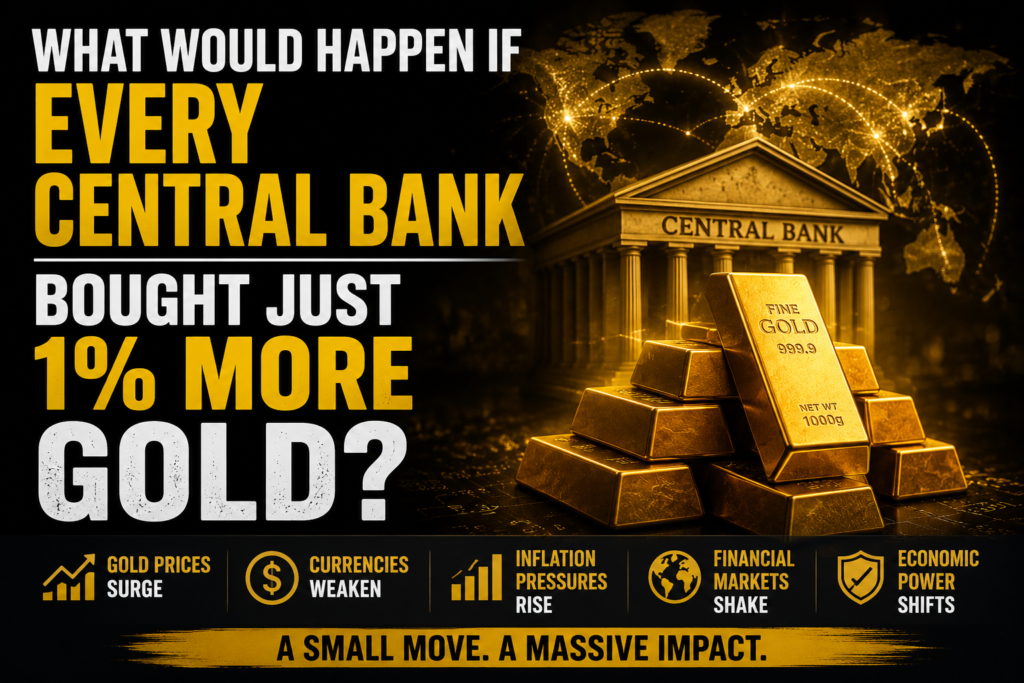
What Would Happen If Every Central Bank Bought Just 1% More Gold?
Imagine waking up tomorrow to a single announcement:
Every central bank in the world has decided to increase its gold reserves by just 1%.
At first glance, it doesn’t sound dramatic.
Just 1%.
Not 20%.
Not 50%.
Not a massive buying spree.
Yet in the global gold market, even a small coordinated increase in official demand could have significant implications because gold is a finite asset with relatively stable annual mine production.
The question isn’t whether this scenario will happen tomorrow.
The real question is:
Could a modest increase in central bank demand be enough to reshape the gold market?
Why Central Banks Own Gold
Unlike individual investors, central banks don’t buy gold for short-term profits.
They hold gold because it:
- Diversifies foreign exchange reserves.
- Carries no issuer or counterparty risk.
- Can act as a reserve asset during periods of financial stress.
- Is widely recognized and liquid in global markets.
For decades, gold has remained part of the reserve strategies of many countries, even as currencies and financial systems have evolved.
The Scale of Central Bank Gold Holdings
Collectively, central banks hold tens of thousands of tonnes of gold as part of their official reserves.
These reserves represent one of the largest long-term sources of demand in the gold market.
Unlike speculative traders, central banks typically hold gold over long periods, reducing the amount that returns to the market.
Why Just 1% Matters
One percent sounds small.
In personal finance, it often is.
In sovereign reserves, it’s different.
A 1% increase applied across central bank reserve strategies would represent additional demand from institutions that generally buy for strategic rather than short-term reasons.
Gold supply cannot expand overnight.
New mining projects often take many years to develop, and annual production changes gradually.
That means sustained increases in official-sector demand could tighten the balance between supply and demand.
Gold Supply Doesn’t Grow Quickly
Every year, mines produce additional gold, but production growth is typically modest.
Building a new mine requires:
- Geological exploration.
- Environmental approvals.
- Financing.
- Infrastructure development.
- Construction.
- Operational ramp-up.
This process often spans many years.
As a result, supply tends to respond slowly to changes in demand.
The Ripple Effect on Investors
If central banks collectively increased purchases, investors might interpret that as a sign of growing confidence in gold’s long-term role.
Possible market reactions could include:
- Increased interest from institutional investors.
- Greater retail participation.
- Higher demand for gold-backed ETFs.
- Stronger attention to physical bullion.
These reactions would depend on the broader economic environment rather than the purchases alone.
Why Countries Continue Holding Gold
Central banks manage reserves for stability rather than speculation.
Gold can complement other reserve assets because it is not tied to the creditworthiness of any single government or corporation.
During periods of economic uncertainty, this characteristic can become more prominent in reserve management discussions.
Could Prices Rise?
Higher official demand does not automatically guarantee higher prices.
Gold prices are also influenced by:
- Interest rates.
- Inflation expectations.
- Treasury yields.
- Currency movements.
- The U.S. dollar.
- Investment flows.
- Jewelry demand.
- Mine supply.
- Recycling.
However, stronger structural demand from central banks could become one supportive factor if other market conditions align.
The Psychological Impact Could Be Even Bigger
Markets respond not only to numbers but also to expectations.
If investors believed central banks were increasing their allocation to gold, many might ask:
- What are policymakers preparing for?
- Why is gold becoming more important?
- Should portfolios include more precious metals?
Changes in expectations can sometimes influence markets as much as changes in physical demand.
What History Suggests
Over the past two decades, official-sector gold purchases have often been viewed as an important component of long-term demand.
Rather than trading frequently, central banks generally make strategic allocation decisions.
This steady approach can contribute to market confidence over time.
Three Possible Outcomes
Scenario 1: Gradual Market Support
A measured increase in reserve demand could provide long-term support without causing dramatic short-term price movements.
Scenario 2: Stronger Investor Confidence
Institutional and retail investors could interpret increased official buying as a positive signal for gold’s long-term role.
Scenario 3: Broader Portfolio Diversification
If reserve managers allocate slightly more to gold, private investors may also reassess portfolio diversification strategies.
What Investors Should Watch
Rather than focusing on one hypothetical event, investors should monitor:
- Official central bank reserve reports.
- Inflation trends.
- Federal Reserve and other major central bank policies.
- U.S. Treasury yields.
- Dollar Index (DXY).
- Gold ETF flows.
- Geopolitical developments.
- Global mine production.
These factors together provide a more complete picture of the gold market.
Final Analysis
A 1% increase in central bank gold holdings may appear modest, but in the context of global reserves, it represents meaningful strategic demand.
Because gold supply expands gradually while central banks generally buy with long-term objectives, even relatively small shifts in reserve allocation can influence market sentiment.
Whether such a scenario would lead to significantly higher prices would depend on a combination of factors, including inflation, interest rates, the U.S. dollar, investor demand, and broader economic conditions.
The key lesson is that gold’s market is shaped not only by daily trading but also by the long-term decisions of institutions managing national reserves.
If those institutions continue to place greater emphasis on gold, investors around the world are likely to pay close attention.
📌 Key Highlights
- 🏦 Central banks collectively hold tens of thousands of tonnes of gold in official reserves.
- 📈 Even a 1% increase in reserve allocations could represent meaningful additional demand.
- ⛏️ Gold mine supply grows gradually, making the market relatively slow to respond to demand changes.
- 🌍 Official-sector buying is often viewed as a long-term structural factor in the gold market.
- 💵 Gold prices also depend on interest rates, inflation, the U.S. dollar, ETF flows, and investor sentiment.
❓FAQs
Why do central banks hold gold?
Gold helps diversify reserves, carries no issuer risk, and serves as a globally recognized reserve asset.
Would a 1% increase in central bank buying guarantee higher gold prices?
No. Gold prices are influenced by many factors, including interest rates, inflation, currency movements, investor demand, and overall economic conditions.
Can gold supply increase quickly?
Generally no. Developing new gold mines typically takes years, so supply tends to adjust gradually.
Why do investors monitor central bank purchases?
Official-sector buying can provide insight into long-term reserve management strategies and is often considered an important structural component of gold demand.
About GoldPriceNow
GoldPriceNow delivers daily gold price updates, market analysis, investment insights, and global precious metals coverage to help investors understand the forces shaping the gold market.
Stay Updated with TheBusinessNow.in
For the latest business news, stock market updates, global economic analysis, technology trends, and investment insights, visit TheBusinessNow.in and stay informed about the markets that matter.
Related Articles
 Gold News
U.S. Treasury Doubles Bond Buybacks — Is Gold Getting a New Bullish Signal?
U.S. Treasury Doubles Bond Buybacks — Is Gold Getting a New Bullish Signal? The U.S. Treasury has just delivered a…
 Gold News
Gold Price Today Outlook as US Debt Crosses $40 Trillion and Treasury Yields Surge
Gold Price Today Outlook as US Debt Crosses $40 Trillion and Treasury Yields Surge The gold price today is facing…
 Investment Guides
Gold Price Today Outlook — US Jobs Data Could Decide Whether Gold Breaks Higher or Pulls Back
Gold Price Today Outlook — US Jobs Data Could Decide Whether Gold Breaks Higher or Pulls Back The gold price…