
Trump’s Trade Reset Is Rewriting Global Risk—Here’s Why Gold Could Be One of the Biggest Beneficiaries
July 24, 2026 · GoldPriceNow · 3 min read
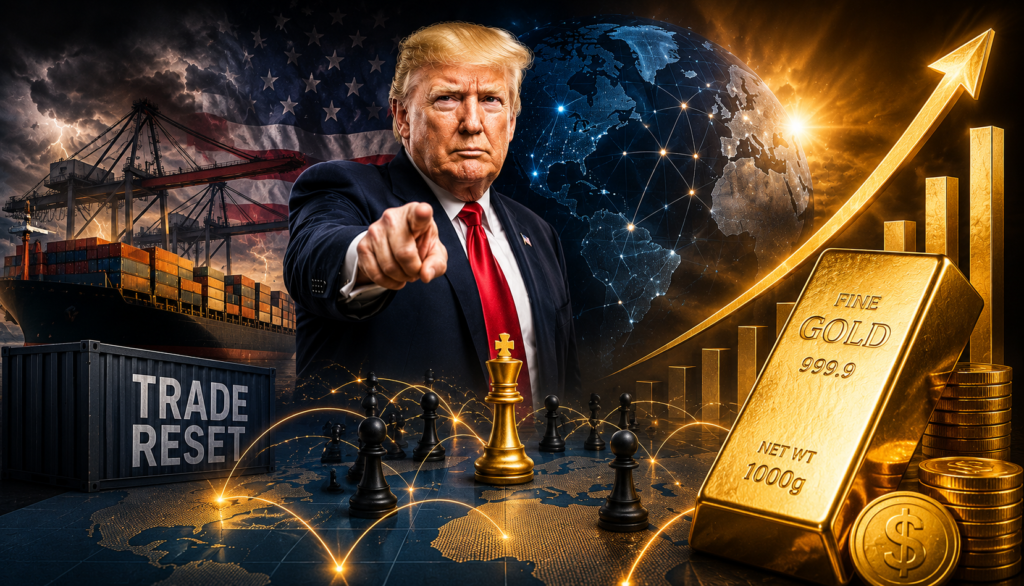
Trump’s Trade Reset Is Rewriting Global Risk—Here’s Why Gold Could Be One of the Biggest Beneficiaries
President Donald Trump’s latest trade announcements—including a potential tariff reversal and a Section 301 investigation into EU penalties on U.S. firms—have injected fresh uncertainty into global markets. As investors assess the impact on inflation, trade relations, the U.S. dollar, and economic growth, gold is once again emerging as a key safe-haven asset. This analysis explores how Trump’s evolving trade strategy could influence gold prices, central bank buying, market sentiment, and whether the precious metal is preparing for its next major move.
Key Highlights
- 🌍 Trump’s latest trade announcements have put global markets back on alert.
- 📈 A new Section 301 investigation could reignite US-EU trade tensions.
- 💰 Gold historically performs well during periods of geopolitical and trade uncertainty.
- 🏦 Central banks remain major buyers of gold despite market volatility.
- 📊 Investors are closely watching whether trade disputes spill into currency and bond markets.
Global Markets Have a New Risk to Watch
Just as investors were beginning to focus on inflation, interest rates, and central bank policy, global trade has returned to the spotlight.
Recent comments from U.S. President Donald Trump indicate a potential reset in U.S. trade policy, including:
- Reversing existing trade penalties.
- Planning substantial new tariffs.
- Launching a Section 301 investigation into fines imposed by the European Union on U.S. companies.
While these announcements are primarily about trade policy, financial markets often view such developments through a different lens: risk.
And when global risk rises, gold frequently attracts renewed attention.
Why Trade Policy Matters for Gold
Gold is not directly affected by tariffs.
Instead, gold reacts to uncertainty.
When businesses become uncertain about future trade costs, supply chains, investment decisions, and economic growth, investors often seek assets that are less dependent on corporate earnings or government policies.
Historically, major trade disputes have influenced:
- Currency markets
- Equity market volatility
- Bond yields
- Inflation expectations
- Safe-haven demand
Gold sits at the center of that safe-haven ecosystem.
What Is a Section 301 Investigation?
Section 301 is a U.S. trade mechanism that allows authorities to investigate foreign trade practices considered unfair to American businesses.
If such investigations conclude that another country or economic bloc is engaging in discriminatory practices, the United States can respond with measures such as additional tariffs or other trade actions.
Although investigations do not automatically lead to tariffs, markets often begin pricing in the possibility well before any formal decision.
That anticipation alone can influence investor behavior.
Why Investors Are Paying Attention
Markets dislike uncertainty more than bad news.
If businesses cannot accurately estimate future trade costs, they often delay investment and expansion.
That uncertainty can spread across:
- Manufacturing
- Technology
- Automotive
- Consumer goods
- Logistics
- Global shipping
As uncertainty rises, portfolio managers frequently diversify into assets viewed as stores of value.
Gold has historically been one of those assets.
Could This Increase Inflation?
One reason trade disputes attract so much attention is their potential impact on prices.
Higher import costs may eventually translate into:
- Higher manufacturing expenses
- More expensive consumer goods
- Supply chain adjustments
- Increased transportation costs
If inflation expectations begin rising while economic growth slows, investors often become more interested in defensive assets.
Gold has historically been one of the assets monitored during such periods.
Why Central Banks Continue Buying Gold
Another important factor supporting gold is official demand.
In recent years, central banks across multiple regions have increased their gold reserves as part of broader reserve diversification strategies.
Reasons include:
- Reducing dependence on foreign currencies
- Portfolio diversification
- Long-term financial stability
- Managing geopolitical uncertainty
Trade disputes do not necessarily trigger central bank buying, but prolonged geopolitical uncertainty can reinforce the case for holding gold as part of national reserves.
Markets Beyond Gold Could Also React
If trade tensions intensify, investors may also watch:
| Market | Possible Reaction |
|---|---|
| US Dollar | Higher volatility depending on policy expectations |
| Global Stocks | Increased short-term swings |
| Treasury Bonds | Demand may rise if investors seek safety |
| Oil | Sensitive to global growth expectations |
| Industrial Metals | Dependent on manufacturing outlook |
Gold often moves alongside these broader shifts in investor sentiment rather than in isolation.
What Could Happen Next?
Several scenarios could influence the gold market:
Scenario 1: Trade Negotiations Ease
If discussions between the United States and the European Union progress positively, market anxiety could moderate, potentially reducing immediate safe-haven demand.
Scenario 2: New Tariffs Are Implemented
If additional tariffs are announced, markets may reassess global growth expectations, increasing volatility across equities, currencies, and commodities.
Scenario 3: Trade Uncertainty Persists
Even without immediate tariffs, prolonged uncertainty can keep investors focused on defensive assets, including gold.
What Should Gold Investors Watch?
Instead of reacting to headlines alone, investors should monitor:
- Official U.S. trade announcements
- European Union responses
- Dollar Index (DXY)
- Treasury yields
- Inflation expectations
- Federal Reserve communications
- Central bank gold reserve data
- Global equity market volatility
These indicators often provide a broader context for gold price movements.
The Bigger Picture
Trade policy is no longer just about imports and exports.
It influences business confidence, investment decisions, inflation expectations, currency movements, and global capital flows.
Whether the latest U.S. trade initiatives develop into a prolonged dispute or remain part of ongoing negotiations, investors are likely to monitor the potential impact on financial markets.
For gold, the key question is not simply whether tariffs increase, but whether uncertainty remains elevated. If global risk perceptions rise, gold could continue to play its traditional role as a widely watched defensive asset.
Frequently Asked Questions
Why does gold react to trade tensions?
Gold often attracts investor interest during periods of economic or geopolitical uncertainty because it is viewed by many as a defensive asset.
What is Section 301?
Section 301 is a U.S. trade law that allows investigations into foreign trade practices considered unfair and can lead to trade actions if warranted.
Will new tariffs automatically push gold prices higher?
Not necessarily. Gold prices depend on multiple factors, including interest rates, inflation, the U.S. dollar, central bank activity, and overall market sentiment.
What indicators should investors monitor?
Key indicators include trade policy announcements, inflation data, Federal Reserve decisions, Treasury yields, currency movements, and geopolitical developments.
About GoldPriceNow
GoldPriceNow delivers live gold prices, global market analysis, precious metals insights, economic calendar coverage, and data-driven forecasts to help investors stay informed in a rapidly changing financial landscape.
Related Articles
 Gold News
U.S. Treasury Doubles Bond Buybacks — Is Gold Getting a New Bullish Signal?
U.S. Treasury Doubles Bond Buybacks — Is Gold Getting a New Bullish Signal? The U.S. Treasury has just delivered a…
 Gold News
Gold Price Today Outlook as US Debt Crosses $40 Trillion and Treasury Yields Surge
Gold Price Today Outlook as US Debt Crosses $40 Trillion and Treasury Yields Surge The gold price today is facing…
 Investment Guides
Gold Price Today Outlook — US Jobs Data Could Decide Whether Gold Breaks Higher or Pulls Back
Gold Price Today Outlook — US Jobs Data Could Decide Whether Gold Breaks Higher or Pulls Back The gold price…