
The Hidden Clock That Controls the Global Gold Market: Why Gold Prices Move Before Most Investors Wake Up
July 21, 2026 · GoldPriceNow · 6 min read
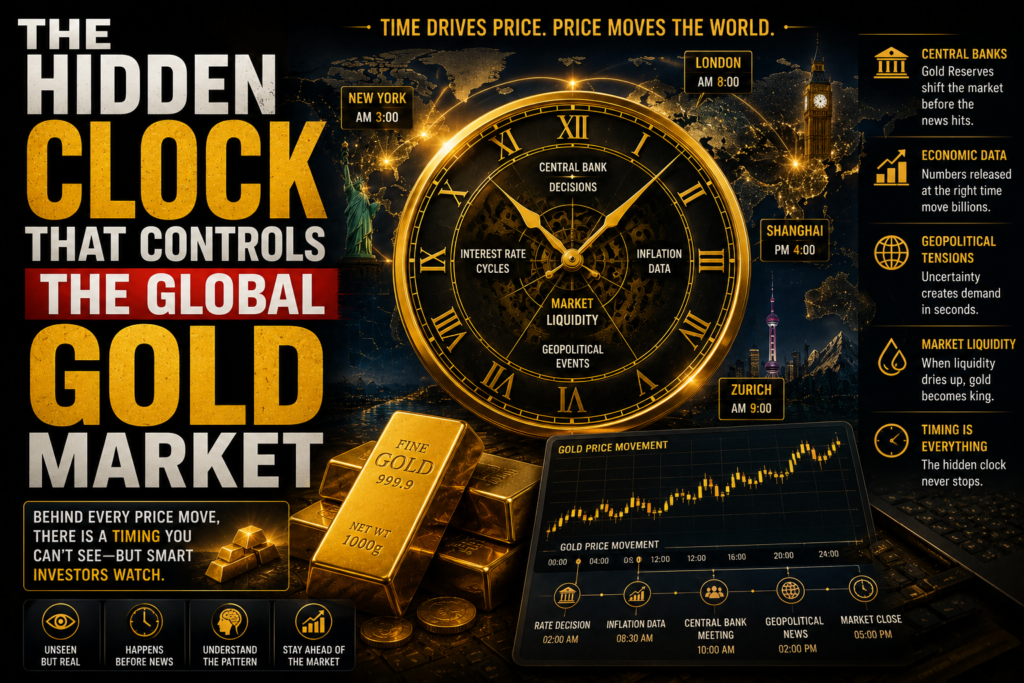
The Hidden Clock That Controls the Global Gold Market
Every day, millions of investors check the gold price.
Some see it rising.
Some see it falling.
Most assume the movement is random.
But behind every major gold rally—or sudden selloff—there is an invisible system operating almost continuously.
Think of it as a hidden global clock.
It doesn’t appear on television.
It isn’t displayed on trading platforms.
Yet it quietly influences the price of gold 24 hours a day, moving from one financial center to another as the Earth rotates.
Understanding this “clock” helps explain why gold often moves before the biggest news headlines appear.
Gold Never Really Sleeps
Unlike many stock markets that trade only during local business hours, gold is traded almost around the clock.
As one major financial center closes, another opens.
This creates a continuous chain of trading activity across the globe.
The cycle typically moves through:
- 🌏 Asia (Sydney, Hong Kong, Shanghai)
- 🌍 Europe (London, Zurich)
- 🌎 North America (New York)
Instead of one exchange controlling prices, global participants collectively determine the market through continuous buying and selling.
📌 Key Highlights
- 🌍 Gold trading follows a nearly 24-hour global cycle.
- 🇬🇧 London remains a major hub for institutional and physical gold trading.
- 🇺🇸 New York often sees the largest price swings due to futures trading and economic data.
- 🇨🇳 Asian demand plays a significant role in setting the day’s initial market tone.
- 🏦 Central bank actions can influence gold trends over both the short and long term.
- 💵 The US dollar and interest-rate expectations remain key drivers of gold prices.
- 📈 Understanding the market’s daily rhythm helps explain why gold often moves before major headlines.
Asia Often Sets the First Tone
The trading day usually begins in the Asia-Pacific region.
Markets here frequently respond to:
- Overnight geopolitical developments.
- Currency movements.
- Physical gold demand.
- Regional economic data.
China and India remain among the world’s largest consumers of physical gold, making Asian trading sessions especially important during periods of strong jewelry demand or seasonal buying.
London Remains the Heart of Physical Gold Trading
Although trading occurs globally, London continues to play a central role in the international gold market.
Large institutions, bullion banks, refiners, and commercial participants use London as one of the key hubs for physical gold transactions.
During London trading hours:
- Institutional liquidity increases.
- Physical gold trading becomes more active.
- Price discovery often strengthens.
Many global investors closely monitor London because significant price moves frequently develop during this session.
New York Brings the Biggest Volatility
When New York opens, trading activity often accelerates.
Several factors contribute:
- High trading volume.
- Institutional participation.
- Futures market activity.
- US economic data releases.
- Federal Reserve commentary.
Major announcements such as:
- Inflation reports
- Employment data
- GDP releases
- Federal Reserve decisions
can trigger rapid price movements within minutes.
The Overlap Hours Matter Most
One of the most important periods each trading day occurs when London and New York are open simultaneously.
During this overlap:
- Liquidity is at its highest.
- Trading volume increases sharply.
- Large institutional orders enter the market.
- Gold often experiences its biggest intraday moves.
Professional traders pay close attention to this window because it frequently sets the day’s direction.
Central Banks Influence the Clock Too
Not every gold move comes from investors.
Central banks also play an important role.
Their actions include:
- Buying gold reserves.
- Adjusting monetary policy.
- Managing foreign exchange reserves.
- Influencing interest-rate expectations.
When central banks signal changes in policy, gold markets often react almost immediately.
The US Dollar Is One of Gold’s Biggest Drivers
Gold and the US dollar often share an important relationship.
When the dollar strengthens significantly, gold may face pressure.
When the dollar weakens, gold can become more attractive for international buyers.
This relationship isn’t perfect, but currency markets frequently influence gold trading throughout the day.
Economic Data Acts Like Alarm Bells
Certain scheduled events repeatedly influence the hidden clock.
Markets pay close attention to:
- US Consumer Price Index (CPI)
- Producer Price Index (PPI)
- Non-Farm Payrolls (NFP)
- Federal Reserve meetings
- GDP reports
- Retail sales
- Manufacturing data
These reports can reshape expectations about inflation and interest rates, both of which are major drivers of gold prices.
Geopolitical Events Can Override Everything
While the market follows a regular daily rhythm, unexpected events can interrupt it instantly.
Examples include:
- Military conflicts.
- Trade disputes.
- Banking stress.
- Energy supply disruptions.
- Major elections.
During periods of uncertainty, investors often seek assets viewed as defensive, increasing attention on gold.
Why Retail Investors Often Miss the Move
Many retail investors react only after headlines appear.
Professional investors often monitor:
- Trading sessions.
- Economic calendars.
- Bond yields.
- Currency markets.
- Central bank communication.
- Institutional positioning.
By the time mainstream news reports a sharp gold rally, a significant portion of the move may already have occurred.
What the Hidden Clock Means for Investors
Understanding the global trading cycle doesn’t guarantee profitable trades.
However, it helps explain why gold behaves differently from many other assets.
Key lessons include:
- Gold is influenced by global—not local—events.
- Trading activity changes as financial centers open and close.
- Economic data releases often trigger volatility.
- Central bank decisions can reshape long-term trends.
- Monitoring the broader macroeconomic environment provides useful context.
Could This Clock Become Even More Important?
Several long-term developments may increase the importance of global gold trading:
- Continued central bank gold purchases.
- Higher geopolitical uncertainty.
- Persistent inflation concerns.
- Greater global demand for reserve diversification.
- Expanded participation from emerging economies.
As these forces evolve, the global gold market may become even more interconnected.
Conclusion
The Hidden Clock That Controls the Global Gold Market isn’t a single algorithm or secret institution.
It is the continuous interaction of global trading sessions, central bank policies, economic releases, currency markets, and investor sentiment.
Gold doesn’t wait for tomorrow’s headlines.
It responds in real time as the world rotates from Asia to Europe to North America.
For investors, understanding this hidden rhythm can provide valuable context for why gold prices sometimes move before the news catches up.
Frequently Asked Questions
Does one country control global gold prices?
No. Gold prices are determined through continuous global trading involving financial institutions, exchanges, central banks, and investors across multiple regions.
Why is London important for gold?
London remains one of the world’s primary centers for physical bullion trading and institutional price discovery.
Why does gold often move after US economic data?
US economic reports influence expectations for inflation, interest rates, and the US dollar, all of which can affect gold prices.
Is gold traded 24 hours a day?
Gold trading occurs nearly continuously during the business week as markets in Asia, Europe, and North America open and close in sequence.
About GoldPriceNow
GoldPriceNow delivers trusted coverage of gold prices, silver rates, precious metals news, investment analysis, market trends, and global economic developments. Whether you’re tracking daily gold prices or researching long-term investment strategies, GoldPriceNow provides timely insights to help you make informed financial decisions.
External Authority Sources
Related Articles
 Gold News
U.S. Treasury Doubles Bond Buybacks — Is Gold Getting a New Bullish Signal?
U.S. Treasury Doubles Bond Buybacks — Is Gold Getting a New Bullish Signal? The U.S. Treasury has just delivered a…
 Gold News
Gold Price Today Outlook as US Debt Crosses $40 Trillion and Treasury Yields Surge
Gold Price Today Outlook as US Debt Crosses $40 Trillion and Treasury Yields Surge The gold price today is facing…
 Investment Guides
Gold Price Today Outlook — US Jobs Data Could Decide Whether Gold Breaks Higher or Pulls Back
Gold Price Today Outlook — US Jobs Data Could Decide Whether Gold Breaks Higher or Pulls Back The gold price…