
Middle East Tensions and Gold: Could the Next Global Shock Push Prices Higher?
July 21, 2026 · GoldPriceNow · 6 min read
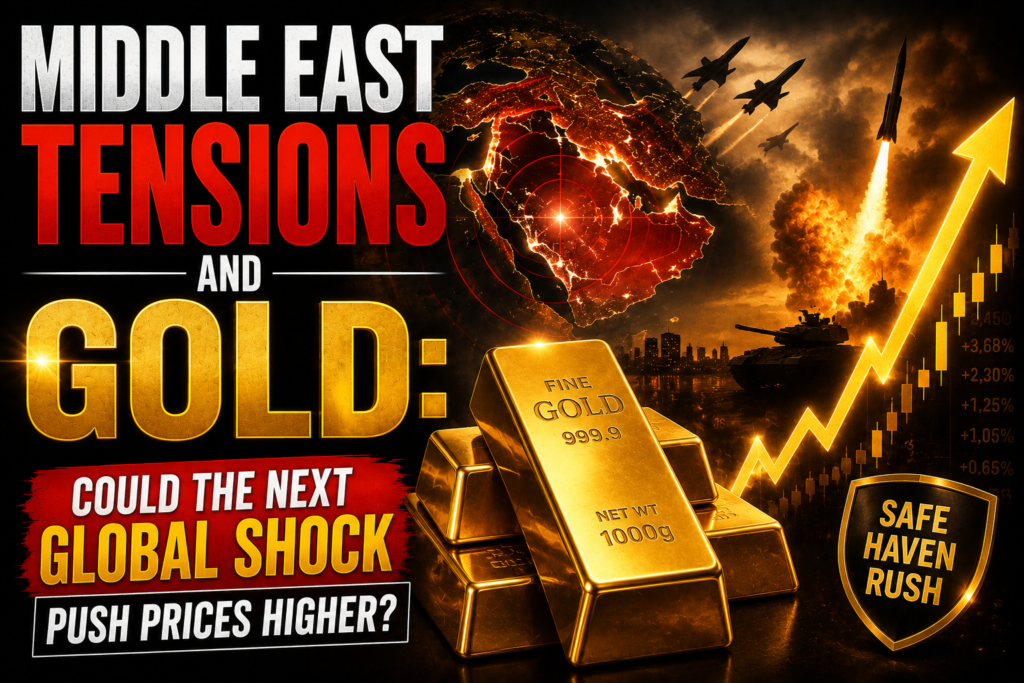
Middle East Tensions and Gold: Could the Next Global Shock Push Prices Higher?
Every major geopolitical crisis eventually reaches financial markets. Sometimes the reaction is brief. Sometimes it reshapes investment trends for months.
As investors closely watch developments in the Middle East, one question is becoming increasingly important:
Could escalating regional tensions trigger another wave of demand for gold?
Gold has historically attracted attention during periods of geopolitical uncertainty, but markets are rarely driven by headlines alone. Oil prices, inflation expectations, central bank policy, the U.S. dollar, and investor psychology all interact to determine whether gold strengthens—or whether the initial reaction fades.
For investors, understanding these relationships is far more valuable than reacting emotionally to breaking news.
Why the Middle East Matters to Global Markets
The Middle East plays a critical role in:
- Global oil production.
- Major shipping routes.
- Energy exports.
- International trade.
- Regional security.
Disruptions in any of these areas can influence markets far beyond the region.
If uncertainty increases, investors often reassess risk across multiple asset classes, including equities, bonds, currencies, and commodities.
Why Gold Often Gains Attention During Geopolitical Stress
Gold has long been viewed as a safe-haven asset.
During periods of uncertainty, investors sometimes reduce exposure to riskier assets and increase allocations to defensive investments.
This doesn’t mean gold always rises during every conflict, but geopolitical events have historically been one factor that can increase demand.
The Chain Reaction Markets Are Watching
If regional tensions intensify, investors will likely monitor several connected developments.
Geopolitical Tensions

          ↓

Higher Oil Prices

          ↓

Inflation Expectations

          ↓

Central Bank Policy Expectations

          ↓

Bond Yields & US Dollar

          ↓

Gold Price Reaction
The gold market is influenced by the entire chain—not just the initial news.
Scenario 1: Oil Prices Move Higher
One of the first markets to react to Middle East developments is often crude oil.
Higher oil prices can:
- Increase transportation costs.
- Raise manufacturing expenses.
- Push inflation expectations higher.
- Influence central bank decisions.
If inflation concerns grow, some investors may increase exposure to gold as part of a diversified strategy.
Scenario 2: Investors Seek Safety
Periods of uncertainty often change investor behavior.
Some investors may:
- Reduce equity exposure.
- Increase cash holdings.
- Buy government bonds.
- Allocate more to gold.
These shifts are driven by risk management rather than speculation.
Scenario 3: The U.S. Dollar Complicates the Picture
Gold and the U.S. dollar often have an inverse relationship, but during major global events they can sometimes strengthen at the same time.
Why?
Because both can be viewed as defensive assets.
If investors seek safety broadly, demand for both the dollar and gold may rise simultaneously.
Central Banks Are Watching Too
Central banks closely monitor geopolitical developments because they can affect:
- Inflation.
- Currency stability.
- Financial conditions.
- Economic growth.
Although central bank reserve decisions are generally long-term, continued institutional demand has remained an important feature of the gold market in recent years.
Markets Don’t React Only to the News
One of the biggest mistakes investors make is assuming that dramatic headlines automatically mean dramatic market moves.
Markets respond to:
- The severity of developments.
- Expectations versus reality.
- Duration of uncertainty.
- Economic consequences.
Sometimes prices move before headlines become widespread because markets anticipate events.
What History Suggests
Looking back at periods of heightened geopolitical uncertainty, gold has often experienced increased demand.
However, historical performance also shows:
| Market Condition | Typical Gold Response |
|---|---|
| Short-lived geopolitical event | Temporary support possible |
| Prolonged uncertainty | Increased safe-haven demand may persist |
| Rising inflation expectations | Can support gold |
| Higher real interest rates | May create headwinds |
| Strong U.S. dollar | Can offset some gains |
History provides context—but it does not guarantee future outcomes.
The Bigger Story Isn’t Just the Middle East
Professional investors rarely focus on a single headline.
They also evaluate:
- Federal Reserve policy.
- Inflation reports.
- Treasury yields.
- U.S. dollar strength.
- Gold ETF flows.
- Central bank purchases.
- Global economic growth.
Gold’s direction depends on how these factors interact.
What Professional Investors Watch First
Rather than reacting immediately, many institutional investors monitor:
✅ Oil markets.
✅ Treasury yields.
✅ The U.S. Dollar Index.
✅ Gold ETF inflows.
✅ Inflation expectations.
✅ Volatility indexes.
These indicators often provide additional context beyond the initial news.
What Could Support Gold?
Gold could find support if:
- Energy prices rise significantly.
- Inflation expectations increase.
- Investors seek defensive assets.
- Financial market volatility increases.
- Central banks continue long-term diversification.
What Could Limit Gold’s Gains?
Gold may face pressure if:
- The U.S. dollar strengthens sharply.
- Real interest rates rise.
- Tensions ease quickly.
- Investors rotate back into risk assets.
This is why gold’s reaction to geopolitical events is rarely one-dimensional.
Key Indicators to Watch
| Indicator | Why It Matters |
|---|---|
| Brent & WTI Oil | Inflation expectations |
| U.S. Dollar Index | Currency impact |
| Treasury Yields | Opportunity cost of holding gold |
| Gold ETF Flows | Investor demand |
| Inflation Data | Monetary policy expectations |
| Central Bank Commentary | Long-term market outlook |
Final Analysis
Middle East developments deserve attention because they have the potential to influence energy markets, inflation expectations, investor sentiment, and central bank thinking.
Whether gold moves meaningfully higher will depend less on headlines themselves and more on how those headlines affect the broader economic landscape.
For investors, the most productive approach is to monitor the underlying drivers—oil prices, interest rates, inflation, and market positioning—rather than assuming a particular outcome.
Gold has historically played an important role during periods of uncertainty, but like any asset, its future performance will reflect a combination of economic, financial, and geopolitical forces.
📌 Key Highlights
- 🌍 Middle East developments can influence oil prices, inflation, and investor sentiment.
- 🛢️ Rising energy costs may affect expectations for inflation and monetary policy.
- 🪙 Gold often attracts attention during periods of heightened uncertainty, though outcomes vary.
- 💵 The U.S. dollar, Treasury yields, and ETF flows remain key indicators alongside geopolitical news.
- 📊 Long-term investors typically evaluate multiple factors rather than reacting to headlines alone.
❓FAQs
Do geopolitical tensions always push gold higher?
Not necessarily. Gold often benefits from increased uncertainty, but its price is also influenced by interest rates, the U.S. dollar, inflation, and broader market conditions.
Why do oil prices matter for gold?
Higher oil prices can increase inflation expectations, which may influence central bank policy and investor demand for gold.
Can gold and the U.S. dollar rise together?
Yes. During periods of significant uncertainty, both assets have at times attracted safe-haven demand simultaneously.
What indicators should gold investors watch?
Oil prices, Treasury yields, inflation data, the U.S. Dollar Index, ETF flows, and central bank communications are among the most closely followed indicators.
About GoldPriceNow
GoldPriceNow delivers trusted coverage of gold prices, silver rates, precious metals news, investment analysis, market trends, and global economic developments. Whether you’re tracking daily gold prices or researching long-term investment strategies, GoldPriceNow provides timely insights to help you make informed financial decisions.
External Authority Sources
Related Articles
 Gold News
U.S. Treasury Doubles Bond Buybacks — Is Gold Getting a New Bullish Signal?
U.S. Treasury Doubles Bond Buybacks — Is Gold Getting a New Bullish Signal? The U.S. Treasury has just delivered a…
 Gold News
Gold Price Today Outlook as US Debt Crosses $40 Trillion and Treasury Yields Surge
Gold Price Today Outlook as US Debt Crosses $40 Trillion and Treasury Yields Surge The gold price today is facing…
 Investment Guides
Gold Price Today Outlook — US Jobs Data Could Decide Whether Gold Breaks Higher or Pulls Back
Gold Price Today Outlook — US Jobs Data Could Decide Whether Gold Breaks Higher or Pulls Back The gold price…