
Is Gold Still the Best Safe-Haven Investment in 2026? Here’s What Smart Investors Need to Know
July 20, 2026 · GoldPriceNow · 6 min read
Is Gold Still the Best Safe-Haven Investment in 2026? Here’s What Smart Investors Need to Know
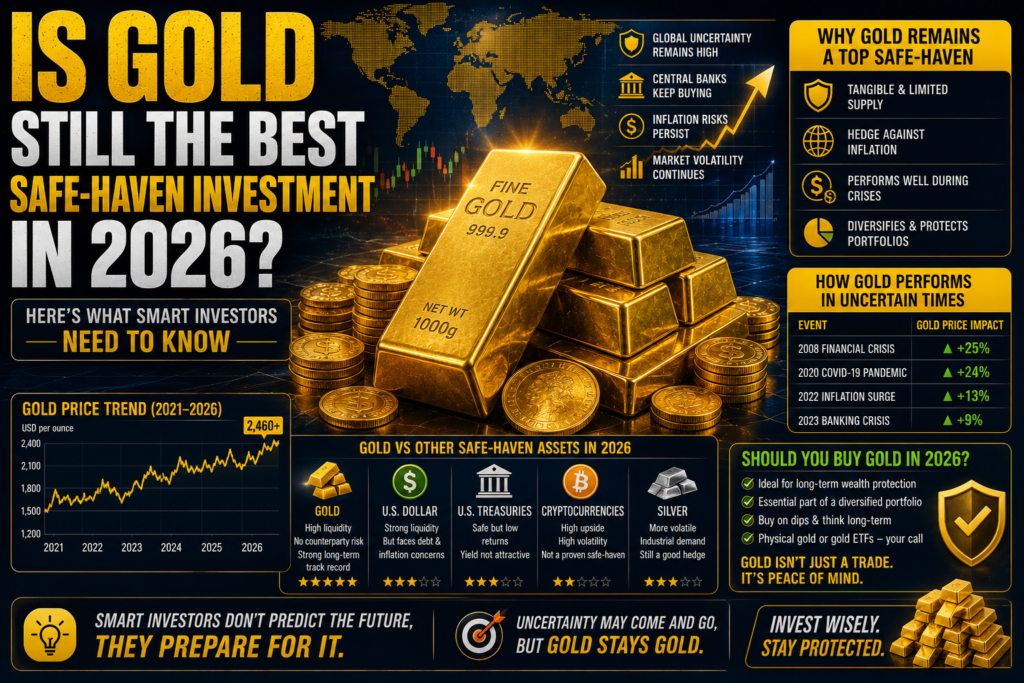
Is Gold Still the Best Safe-Haven Investment in 2026? It’s a question millions of investors are asking as markets navigate inflation, central bank policy, geopolitical tensions, and rapid technological change. Gold has protected wealth through wars, recessions, and financial crises for centuries—but does it still deserve a place in modern portfolios?
While newer assets like cryptocurrencies and AI-driven growth stocks have gained attention, gold continues to play a unique role. Rather than generating income, its value comes from acting as a store of wealth and a diversification tool during periods of uncertainty.
Why Gold Is Called a Safe-Haven Asset
A safe-haven asset is one that investors often turn to during periods of financial or geopolitical stress. Gold has earned this reputation because it is:
- A tangible asset with limited supply.
- Traded globally with deep liquidity.
- Independent of any single government’s monetary policy.
- Widely used by central banks as part of their reserves.
Historically, gold has often attracted increased demand when markets become volatile, although it can also experience periods of price declines.
What Is Driving Gold in 2026?
Several major themes continue to shape the gold market.
1. Central Bank Buying
Many central banks have continued increasing their gold reserves in recent years. This institutional demand has provided long-term support for the market and reflects the role of gold as a reserve asset.
2. Inflation Expectations
Even as inflation has moderated in some economies, investors continue to watch rising prices closely. Gold is frequently viewed as one way to help preserve purchasing power over the long term.
3. Interest Rates
Gold does not pay interest or dividends, so higher interest rates can reduce its relative appeal. Conversely, expectations of lower rates or easing monetary policy often improve sentiment toward gold.
4. Geopolitical Uncertainty
Conflicts, trade disputes, and political instability can increase demand for assets perceived as defensive. Gold has historically benefited during periods of elevated uncertainty, though market reactions vary.
Gold vs. Other Popular Investments
Gold vs. Stocks
Stocks offer long-term growth potential but are generally more volatile. Gold may help diversify a portfolio because it does not always move in the same direction as equities.
Gold vs. Bitcoin
Bitcoin has attracted investors seeking high growth, but it has also experienced sharp price swings. Gold tends to be less volatile and has a much longer history as a store of value.
Gold vs. Bonds
High-quality government bonds remain important defensive assets. However, rising inflation can reduce their real returns, leading some investors to complement bonds with gold.
Gold vs. Cash
Cash provides stability and liquidity, but inflation can erode its purchasing power over time. Gold does not generate income, yet some investors hold it as a hedge against currency weakness and inflation.
Why Investors Still Choose Gold
Gold remains popular for several reasons:
- Portfolio diversification.
- Long history as a store of value.
- Global liquidity.
- Strong demand from central banks.
- Protection during periods of uncertainty.
Rather than replacing stocks or bonds, many investors view gold as one component of a balanced portfolio.
What Could Affect Gold Prices in 2026?
Several factors may influence gold prices over the coming months:
- Federal Reserve interest-rate decisions.
- Inflation data.
- U.S. dollar movements.
- Global economic growth.
- Central bank purchases.
- ETF investment flows.
- Geopolitical developments.
No single factor determines gold prices, which are influenced by a combination of market expectations and global economic conditions.
Is Gold Overvalued?
After periods of strong gains, investors naturally ask whether gold has become expensive.
There is no universally accepted answer. Analysts evaluate gold using different measures, including real interest rates, inflation expectations, currency movements, and long-term historical trends. Because these drivers change over time, opinions on valuation often differ.
Should You Buy Gold in 2026?
Whether to invest in gold depends on your financial objectives, investment horizon, and tolerance for risk.
Gold may appeal to investors who:
- Want greater portfolio diversification.
- Seek exposure to a traditional safe-haven asset.
- Wish to hedge against inflation or geopolitical uncertainty.
Investors focused primarily on long-term growth may prefer a diversified mix of equities while using gold as a complementary holding rather than a replacement.
Outlook: Can Gold Stay Strong?
Gold’s outlook will depend on how inflation, interest rates, the U.S. dollar, and global events evolve.
If inflation remains persistent, geopolitical tensions continue, or central banks maintain strong buying, gold could remain well supported. On the other hand, stronger economic growth, higher real interest rates, or a stronger U.S. dollar may reduce demand.
Rather than attempting to predict short-term price movements, many long-term investors focus on the role gold plays within an overall investment strategy.
Key Takeaways
- 🪙 Gold continues to be one of the world’s most recognized safe-haven assets.
- 🌍 Central bank demand remains an important long-term market driver.
- 📈 Inflation, interest rates, and the U.S. dollar continue to influence prices.
- ⚖️ Gold can help diversify portfolios but should not be viewed as a guaranteed hedge in every market environment.
- 💼 Many investors use gold alongside stocks and bonds rather than as a standalone investment.
Frequently Asked Questions
Is gold still a safe-haven investment in 2026?
Gold continues to be widely regarded as a traditional safe-haven asset, although its price can still fluctuate based on economic and market conditions.
Does gold perform well during inflation?
Gold has historically been used by many investors as a hedge against inflation, but its performance varies depending on interest rates, currency movements, and investor sentiment.
Is gold better than Bitcoin?
Gold and Bitcoin serve different purposes. Gold has a long history as a store of value, while Bitcoin is a newer digital asset with higher historical volatility.
How much gold should investors own?
There is no one-size-fits-all allocation. The appropriate amount depends on individual financial goals, risk tolerance, and overall portfolio strategy.
About GoldPriceNow
GoldPriceNow delivers trusted coverage of gold prices, silver rates, precious metals news, investment analysis, market trends, and global economic developments. Whether you’re tracking daily gold prices or researching long-term investment strategies, GoldPriceNow provides timely insights to help you make informed financial decisions.
External Authority Sources
Related Articles
 Gold News
U.S. Treasury Doubles Bond Buybacks — Is Gold Getting a New Bullish Signal?
U.S. Treasury Doubles Bond Buybacks — Is Gold Getting a New Bullish Signal? The U.S. Treasury has just delivered a…
 Gold News
Gold Price Today Outlook as US Debt Crosses $40 Trillion and Treasury Yields Surge
Gold Price Today Outlook as US Debt Crosses $40 Trillion and Treasury Yields Surge The gold price today is facing…
 Investment Guides
Gold Price Today Outlook — US Jobs Data Could Decide Whether Gold Breaks Higher or Pulls Back
Gold Price Today Outlook — US Jobs Data Could Decide Whether Gold Breaks Higher or Pulls Back The gold price…