
Gold Price Outlook Turns Intriguing as US Debt Interest Tops $3 Billion a Day — Could Fiscal Stress Fuel the Next Gold Rally?
August 11, 2026 · GoldPriceNow · 1 min read
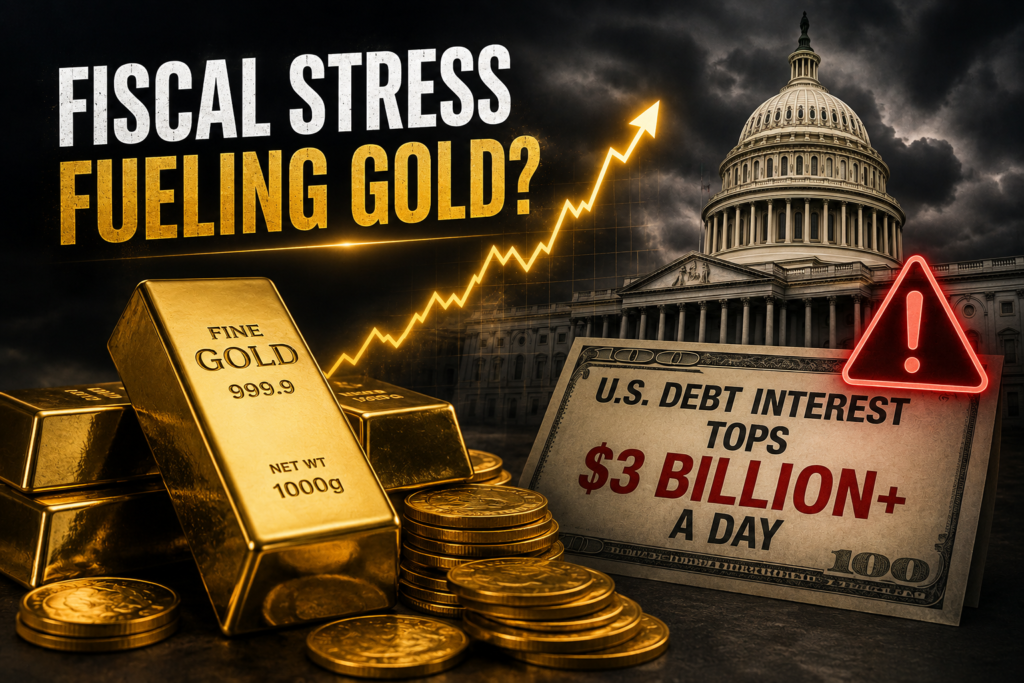
Gold Price Outlook Turns Intriguing as US Debt Interest Tops $3 Billion a Day — Could Fiscal Stress Fuel the Next Gold Rally?
Gold price view: The latest U.S. fiscal numbers are giving gold investors another reason to watch Treasury yields, the U.S. dollar and Federal Reserve policy closely. The Congressional Budget Office says net interest on publicly held U.S. debt reached $963 billion from October 2025 through July 2026, equivalent to roughly $3.18 billion per day over that period. At the same time, the CBO estimates the fiscal-year 2026 deficit at around $2.1 trillion, according to today’s reporting.
That does not mean gold automatically has to rise.
But it creates a powerful macro question for investors:
If America’s borrowing costs keep climbing, does gold become an increasingly attractive hedge against fiscal and currency risk?
For gold traders, the answer depends on what happens next to Treasury yields, real interest rates, the U.S. dollar and expectations for Federal Reserve policy.
Key Highlights
- 🇺🇸 U.S. public-debt interest reached $963 billion during the first 10 months of FY2026.
- 💰 That works out to roughly $3.18 billion per day on average.
- 📉 The CBO’s latest update puts the FY2026 deficit at about $2.1 trillion, according to the latest reporting.
- 📊 The first 10 months of FY2026 produced approximately $1.8 trillion of borrowing/deficit spending.
- 🏦 Higher long-term interest rates are contributing to the rise in debt-service costs.
- 🥇 Gold can benefit if fiscal concerns weaken confidence in the dollar or push investors toward alternative stores of value.
- ⚠️ Higher Treasury yields can simultaneously pressure gold by increasing the opportunity cost of holding a non-yielding asset.
- 🔥 The next major gold move may therefore depend more on real yields and Fed expectations than the headline debt number alone.
Why the US Debt Story Matters for Gold
The U.S. government’s debt problem is becoming increasingly important for financial markets because the government must not only borrow to finance deficits but also pay interest on its existing debt.
The CBO’s latest figures show $963 billion in net interest payments during October 2025-July 2026. That is approximately 14% higher than the comparable period a year earlier, according to the latest reporting.
The increase is being driven partly by the fact that the debt is larger and long-term interest rates are higher.
This creates an unusual feedback loop:
Higher debt → more borrowing → greater interest expense → larger fiscal pressure → greater sensitivity to interest rates.
For gold investors, the critical question is whether that fiscal pressure eventually affects:
- Treasury yields
- inflation expectations
- Federal Reserve policy
- the U.S. dollar
- foreign demand for Treasuries
- investor demand for alternative stores of value
The $3 Billion-a-Day Number Is Eye-Catching — But Don’t Misread It
The headline that the Treasury is spending around $3 billion every day on interest sounds dramatic.
And it is.
But investors should understand what the figure represents.
The CBO’s reported $963 billion is net interest on publicly held debt over the first 10 months of the fiscal year. Dividing that figure by the roughly 303 days in the period produces an average of approximately $3.18 billion per day.
That does not mean the Treasury literally writes a $3.18 billion interest check every 24 hours.
It is an average derived from cumulative fiscal-year interest expenses.
That distinction matters when analyzing the implications for gold.
The Bigger Gold Question Is What Happens to Treasury Yields
This is where the story becomes much more interesting.
A large U.S. deficit can push Treasury issuance higher.
More Treasury supply can place pressure on bond markets if demand does not keep pace.
If yields rise, that can create a headwind for gold.
Why?
Because gold doesn’t pay interest.
If investors can earn significantly higher inflation-adjusted yields on government bonds, holding gold becomes relatively less attractive.
But there’s another side.
If fiscal stress eventually causes markets to expect:
- lower interest rates,
- weaker real yields,
- greater inflation,
- a weaker dollar,
gold can benefit.
That is why U.S. debt is not automatically bullish for gold.
The transmission mechanism matters.
The Gold Bull Case
There are several ways today’s fiscal news could eventually support gold.
1. Fiscal concerns increase demand for safe-haven assets
Investors worried about government debt sustainability may diversify into assets outside traditional sovereign debt.
Gold has historically played this role as a reserve asset and portfolio diversifier.
The World Gold Council’s 2026 research also highlights gold’s role as a strategic asset during periods of uncertainty.
2. Expectations for lower rates could increase
If investors believe high debt-service costs make restrictive monetary policy increasingly difficult to maintain, expectations for future rate cuts could rise.
Lower expected rates generally reduce the opportunity cost of holding gold.
That would be supportive.
3. Real yields could fall
This is arguably more important than the headline federal deficit.
If inflation expectations remain elevated while nominal yields decline, real yields can fall.
Gold historically tends to perform better in environments where real yields are under pressure.
4. Dollar diversification could accelerate
If institutional and official investors become more concerned about concentration in U.S. dollar assets, demand for alternative reserve assets could increase.
Gold is one obvious candidate.
Central-bank gold demand has already become an important structural theme in the global precious-metals market.
But Here’s the Risk for Gold Bulls
There is a major contradiction in the debt story.
Fiscal deterioration can actually hurt gold in the short term if it pushes Treasury yields higher.
Imagine this scenario:
Deficit increases → Treasury issuance rises → bond yields rise → real yields rise → dollar strengthens → gold falls.
That is a very different outcome from:
Deficit increases → confidence weakens → rate-cut expectations increase → real yields fall → dollar weakens → gold rises.
Both are possible.
That’s why today’s U.S. debt headlines should be treated as a gold-market catalyst, not a guaranteed buy signal.
Gold Price Outlook — Three Scenarios
| Scenario | Treasury Yields | Dollar | Gold Bias |
|---|---|---|---|
| Fiscal stress + lower real yields | ↓ | ↓ | 🟢 Strongly bullish |
| Fiscal stress + higher nominal yields | ↑ | ↑/flat | 🔴 Bearish initially |
| Deficit remains high but markets stay calm | Stable | Stable | 🟡 Neutral |
| Fed becomes more dovish | ↓ | ↓ | 🟢 Bullish |
| Inflation reaccelerates | ↑ | Mixed | 🟡 Volatile |
| Recession fears rise | ↓ | ↓/mixed | 🟢 Potentially bullish |
| Strong growth + high yields | ↑ | ↑ | 🔴 Bearish |
Could This Become the Next Major Gold Catalyst?
Potentially.
But traders should not focus solely on the $2.1 trillion deficit.
The more important market signals will be:
Treasury 10-year yield
A sustained decline would generally improve the environment for gold.
10-year real yield
This is particularly important because it measures the inflation-adjusted return available from Treasuries.
U.S. Dollar Index
A weaker dollar can make gold more attractive internationally.
Fed expectations
Markets will closely watch whether fiscal pressures and economic conditions change expectations for future monetary policy.
Treasury auctions
Weak demand at auctions could push yields higher.
Strong demand could help stabilize borrowing costs.
What the Latest Deficit Numbers Actually Say
The latest CBO-related reporting shows the U.S. has borrowed approximately $1.8 trillion during the first 10 months of fiscal 2026.
The CBO’s February baseline had projected a $1.9 trillion FY2026 deficit, equivalent to approximately 5.8% of GDP.
The latest update now points toward roughly $2.1 trillion, according to today’s CRFB summary of the CBO’s monthly update.
That means the fiscal picture is moving in a direction that gold investors cannot easily ignore.
Why Gold Investors Should Watch Japan Too
There is another important piece of the story.
Today’s reporting also connects the Treasury market with movements in the Japanese yen and Japan’s role as a major holder of U.S. debt.
This matters because international Treasury demand can influence U.S. bond yields.
If major foreign investors reduce Treasury exposure, markets can demand higher yields to absorb additional supply.
And again, higher yields can create a short-term headwind for gold.
This is why gold traders need to monitor global bond flows, not just U.S. inflation.
Gold Price Outlook for the Coming Sessions
🟢 Bullish setup
Gold could strengthen if:
- Treasury yields decline
- Real yields fall
- The dollar weakens
- Fed rate-cut expectations increase
- Fiscal concerns intensify
- Geopolitical risk increases
- Central-bank demand remains strong
🟡 Consolidation setup
Gold could move sideways if:
- Treasury yields remain range-bound
- The dollar stabilizes
- Markets wait for inflation and employment data
- Investors take profits after recent gains
🔴 Bearish setup
Gold could experience a correction if:
- Treasury yields surge
- Real yields increase
- The dollar strengthens
- Fed rate-cut expectations decline
- U.S. economic data remain unusually strong
- Investors rotate from defensive assets into riskier investments
The Biggest Mistake Gold Traders Could Make
The biggest mistake would be saying:
“The U.S. deficit is rising, therefore gold must rise.”
Markets are more complicated than that.
Gold responds to the interaction between fiscal policy, monetary policy, inflation, yields, currency markets and investor positioning.
A large deficit can eventually be bullish for gold.
But if the immediate reaction is higher Treasury yields, gold could fall first.
That is why real yields are arguably the most important number to watch after today’s debt headlines.
Gold Price View Today
The latest U.S. fiscal data create a structurally supportive but tactically complicated backdrop for gold.
The bullish argument is straightforward:
record-scale borrowing + rising debt-service costs + persistent deficits → greater fiscal uncertainty → stronger demand for alternative stores of value.
But the bearish counterargument is equally important:
higher Treasury supply + higher long-term yields → stronger opportunity cost of holding gold.
Our market view
Near term: 🟡 Neutral-to-bullish
Medium term: 🟢 Constructive
The bullish case becomes significantly stronger if fiscal concerns begin producing lower real yields and a weaker dollar.
If instead Treasury yields continue climbing aggressively, gold could face a sharp correction before the longer-term fiscal story becomes supportive.
What Gold Investors Should Watch Next
| Indicator | Bullish for Gold | Bearish for Gold |
|---|---|---|
| U.S. 10Y yield | Falling | Rising |
| Real yields | Falling | Rising |
| Dollar | Weakening | Strengthening |
| Fed expectations | More cuts | Fewer cuts |
| Inflation | Rising expectations | Falling expectations |
| Treasury demand | Strong | Weak |
| Geopolitical risk | Increasing | Declining |
| Central-bank gold buying | Increasing | Declining |
| U.S. growth | Weakening | Strengthening |
About Gold Price Now
Gold Price Now is focused on helping readers follow the gold market through live gold prices, gold price forecasts, economic-calendar events, currency-adjusted gold prices, market analysis and major global catalysts.
For investors following the market, the key is not simply knowing whether gold is up or down. Understanding why gold is moving can be even more important.
Today’s U.S. fiscal story is a perfect example.
The headline is about America’s debt.
The market reaction could ultimately be about Treasury yields, the dollar and the Federal Reserve.
And those three variables can determine whether gold’s next major move is a breakout or a correction.
For more business, markets and financial news, visit The Business Now.
FAQs
Is the U.S. debt crisis bullish for gold?
It can be, particularly if fiscal concerns lead to weaker real yields, greater inflation expectations, a weaker dollar or increased demand for alternative reserve assets. It is not automatically bullish.
How much does the U.S. pay in debt interest every day?
Based on CBO figures cited in the latest reporting, net interest totaled $963 billion from October 2025 through July 2026, equivalent to roughly $3.18 billion per day on average.
What is the projected U.S. deficit for 2026?
The latest CBO-related update summarized by CRFB points to approximately $2.1 trillion for FY2026.
Why do Treasury yields matter for gold?
Gold does not pay interest. When inflation-adjusted Treasury yields rise, holding gold can become less attractive relative to bonds. Falling real yields generally create a more supportive environment.
Could gold fall even if the U.S. deficit increases?
Yes. If rising deficits push Treasury yields and the dollar higher, gold can come under short-term pressure.
Is gold a hedge against U.S. debt?
Gold is commonly used as a diversification and store-of-value asset, but it is not a perfect hedge against government debt or inflation. Its price can be highly volatile.
What should gold traders watch now?
Watch the 10-year Treasury yield, 10-year real yield, U.S. Dollar Index, Fed expectations, inflation data, Treasury auctions and employment reports.
Key External Resources
- Congressional Budget Office — The Budget and Economic Outlook — Official U.S. budget and economic projections.
- Committee for a Responsible Federal Budget — Latest CBO deficit update — Analysis of the latest FY2026 borrowing and deficit figures.
- Fortune — CBO debt-interest report — Latest reporting on the approximately $963 billion net-interest figure.
- World Gold Council — Gold Outlook 2026 — Gold-market research and investment outlook.
- World Gold Council — Central Bank Gold Reserves Survey — Central-bank gold demand research.
Related Articles
 Gold News
U.S. Treasury Doubles Bond Buybacks — Is Gold Getting a New Bullish Signal?
U.S. Treasury Doubles Bond Buybacks — Is Gold Getting a New Bullish Signal? The U.S. Treasury has just delivered a…
 Gold News
Gold Price Today Outlook as US Debt Crosses $40 Trillion and Treasury Yields Surge
Gold Price Today Outlook as US Debt Crosses $40 Trillion and Treasury Yields Surge The gold price today is facing…
 Investment Guides
Gold Price Today Outlook — US Jobs Data Could Decide Whether Gold Breaks Higher or Pulls Back
Gold Price Today Outlook — US Jobs Data Could Decide Whether Gold Breaks Higher or Pulls Back The gold price…