
Gold Price Outlook: Strait of Hormuz Uncertainty Keeps Investors on Edge as Iran and Rubio Signal Conflicting Paths
August 4, 2026 · GoldPriceNow · 3 min read
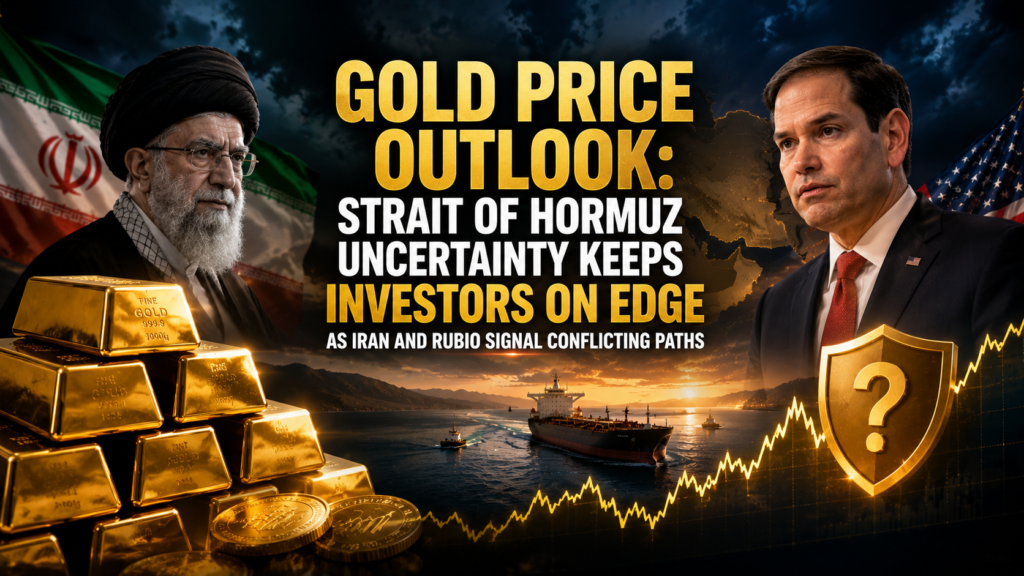
Gold Price Outlook: Strait of Hormuz Uncertainty Keeps Investors on Edge as Iran and Rubio Signal Conflicting Paths
Gold is entering another politically sensitive phase as uncertainty over the Strait of Hormuz collides with signs of progress in talks involving Iran, Oman and the United States. For gold investors, the biggest question is no longer simply whether the strait will reopen—it is how quickly shipping, energy flows and market confidence can actually return to normal.
Recent reports say Iran and Oman have made progress toward an arrangement that could facilitate the reopening of the Strait of Hormuz, while U.S. Secretary of State Marco Rubio has also said progress has been made and that a deal could come “very shortly.”
That creates a fascinating setup for gold prices today: geopolitical risk is potentially easing, but the underlying uncertainty has not disappeared.
Key Highlights
- Gold remains highly sensitive to developments around the Strait of Hormuz.
- Iran and Oman are reportedly making progress toward reopening the critical shipping route.
- Marco Rubio says talks are progressing, but no final agreement has been reached.
- A successful reopening could reduce the geopolitical premium supporting gold.
- A delay, breakdown or renewed disruption could quickly revive safe-haven demand.
- Oil prices are another important signal because energy disruptions can affect inflation expectations and interest-rate expectations.
- The biggest near-term gold moves could come from headlines rather than traditional economic data.
Why the Strait of Hormuz Matters for Gold
The Strait of Hormuz is one of the world’s most important energy chokepoints.
The market does not need the strait to be completely closed for investors to become nervous. Shipping insurance, tanker availability, navigation risks and uncertainty about future energy flows can all influence oil prices and inflation expectations.
The Council on Foreign Relations has highlighted the enormous scale of the disruption associated with the 2026 crisis, noting that more than 10 million barrels per day of oil supply and around 300 million cubic metres per day of LNG were affected for an extended period.
That matters for gold because the chain reaction can look like this:
Hormuz uncertainty → oil volatility → inflation expectations → interest-rate expectations → U.S. dollar and Treasury yields → gold
This is why traders are watching the Middle East even when the immediate headline is about oil rather than gold.
Iran and Rubio Are Sending a Complicated Signal
The market is currently receiving two messages at the same time.
On one side, there are signs of diplomacy.
Reports indicate that Iran and Oman have made progress toward an arrangement aimed at reopening the Strait of Hormuz.
Rubio has separately said there has been progress in talks and expressed hope that an agreement could be reached shortly.
But progress is not the same as resolution.
That distinction is extremely important for gold traders.
A headline saying “talks progressing” can push investors toward risk assets and away from defensive assets. A headline saying “talks collapse” can produce the opposite reaction almost instantly.
This makes the gold market particularly vulnerable to headline-driven volatility.
Gold Price Outlook
The immediate gold outlook can be divided into three scenarios.
| Scenario | Geopolitical Development | Likely Gold Reaction |
|---|---|---|
| Bullish Gold | Talks fail or Hormuz disruption worsens | Strong safe-haven demand |
| Neutral/Volatile | Negotiations continue without final agreement | Choppy two-way trading |
| Bearish Gold | Hormuz reopening becomes credible and risks fade | Safe-haven premium could unwind |
Scenario 1 — Hormuz uncertainty intensifies
This is the strongest bullish scenario for gold.
If negotiations deteriorate, shipping risks increase or the reopening process encounters serious obstacles, investors could once again prioritize capital protection.
Gold could benefit from:
- Safe-haven buying
- Geopolitical hedging
- Higher inflation uncertainty
- Increased demand for defensive assets
- Potential pressure on risk-sensitive markets
The market reaction could become particularly aggressive if geopolitical uncertainty combines with falling equity markets.
Scenario 2 — Talks continue but nothing is finalized
This may be the most interesting scenario for gold price today.
If Iran, Oman and the United States continue negotiations without reaching a final agreement, markets could remain trapped between optimism and fear.
That could create:
Headline → gold falls → new geopolitical headline → gold rebounds → oil moves → dollar reacts → gold reverses again.
For traders, this environment can be more difficult than a clearly bullish or bearish market.
Gold could remain volatile rather than establishing a clean trend.
Scenario 3 — Hormuz Reopens Successfully
This would remove one of the major geopolitical risk premiums from energy markets.
If shipping resumes smoothly and oil supply expectations improve, investors could become more comfortable taking risk.
That could potentially pressure gold through several channels.
Lower geopolitical risk
Investors may reduce safe-haven exposure.
Lower oil risk
A more stable energy market could reduce fears of another inflation shock.
Lower inflation expectations
If energy prices fall or stabilize, markets may anticipate less pressure on central banks.
Higher risk appetite
Capital could move back toward equities and other risk assets.
However, there is an important catch.
A reopening announcement does not automatically mean that global energy markets instantly return to normal.
The CFR notes that reopening involves technical, commercial, operational and geopolitical challenges, including maritime safety and mines in navigation areas.
That means the market could celebrate a reopening headline while traders continue watching the actual flow of tankers.
Oil Prices Could Become Gold’s Hidden Signal
For gold investors, crude oil may be one of the most important markets to monitor.
The relationship isn’t mechanically one-directional, but oil can influence inflation expectations, central-bank policy expectations and broader market sentiment.
Historically, periods of Middle East tension have produced situations where gold and oil react simultaneously to the same geopolitical shock.
Reuters previously reported that gold eased when Middle East tensions pushed oil higher and investors focused on the outlook for U.S. economic data and monetary policy.
That illustrates an important point:
Higher oil does not automatically mean higher gold.
If oil rises because of geopolitical risk, gold may benefit from safe-haven demand.
But if oil rises enough to create a major inflation shock, markets may also expect tighter monetary policy, potentially supporting the dollar and Treasury yields—both of which can weigh on gold.
That’s why today’s gold outlook isn’t as simple as “war equals gold higher.”
The Dollar and Treasury Yields Remain Critical
Even with geopolitical headlines dominating financial media, gold ultimately remains heavily influenced by the U.S. dollar and interest rates.
Gold does not generate interest income.
Therefore, when real yields rise significantly, investors can become more attracted to interest-bearing assets.
Conversely, expectations of easier monetary policy can improve gold’s relative appeal.
This means gold traders should monitor:
- U.S. Dollar Index
- Treasury yields
- Real yields
- Federal Reserve expectations
- Inflation expectations
- Crude oil
- Equity-market volatility
- Middle East headlines
The geopolitical story may trigger the move, but interest rates and the dollar can determine whether that move survives.
Could Gold Break Higher?
Yes—but the catalyst needs to be strong enough.
A renewed geopolitical shock could create another wave of safe-haven demand.
Gold would have an even stronger bullish setup if geopolitical uncertainty coincides with:
- Falling Treasury yields
- A weaker U.S. dollar
- Rising inflation expectations
- Equity-market weakness
- Renewed oil volatility
- Expectations for easier monetary policy
That combination could create a much stronger bullish environment than geopolitical risk alone.
Could Gold Fall Instead?
Absolutely.
If the Strait of Hormuz reopening becomes credible, Iran-related tensions decline and investors begin pricing a more stable energy market, gold could lose part of its geopolitical premium.
A stronger dollar and rising Treasury yields would increase that downside pressure.
This is why investors should avoid assuming that every Middle East headline automatically means gold must rise.
Gold is a multi-factor market.
What Gold Investors Should Watch Next
The next major signals could come from several areas.
1. Strait of Hormuz shipping activity
The difference between an announcement and actual normalization could be significant.
2. Iran-Oman negotiations
Any confirmation of a concrete agreement could reduce immediate geopolitical risk.
3. U.S. statements
Comments from Rubio and other U.S. officials can rapidly change market expectations.
4. Crude oil
A sharp fall in oil could indicate that traders are pricing in improving supply conditions.
5. U.S. dollar
A weakening dollar could provide additional support for gold.
6. Treasury yields
Falling yields could strengthen gold’s appeal.
Gold Price Outlook Today
The short-term setup is best described as volatile with two competing forces.
Bullish force
Geopolitical uncertainty + safe-haven demand
Bearish force
Potential Hormuz reopening + declining geopolitical risk premium
The market therefore has a genuine tug-of-war.
If negotiations produce a concrete and credible reopening process, gold could face selling pressure.
If negotiations stall or the reopening becomes uncertain again, investors could quickly return to defensive positioning.
The biggest risk for gold traders may therefore be headline volatility rather than a single economic indicator.
Final Thoughts
The Strait of Hormuz has become much more than an oil-market story. It is now a major variable for inflation, global trade, monetary policy, currencies and safe-haven assets.
The latest signals are mixed.
Iran and Oman are reportedly making progress, while Marco Rubio has also indicated that talks are advancing. But progress does not guarantee a smooth reopening, and the practical normalization of shipping could take time.
For gold, that means the next major move could depend on whether markets believe the geopolitical risk is actually disappearing—or merely being postponed.
Gold remains vulnerable to sharp moves in either direction.
FAQs
Will the Strait of Hormuz reopening push gold lower?
Potentially. A credible reopening could reduce safe-haven demand and remove some geopolitical risk premium from gold. However, the effect could be limited if inflation, interest rates or the U.S. dollar provide opposing signals.
Why does Hormuz affect gold prices?
Hormuz is a critical energy chokepoint. Disruptions can affect oil prices, inflation expectations, economic growth and monetary-policy expectations, all of which can influence gold.
Is gold still a safe-haven asset?
Gold is widely used as a defensive asset during periods of financial and geopolitical uncertainty, although its price can still decline when the dollar and real yields rise.
Could gold rise if oil prices fall?
Yes. Gold and oil do not always move together. If oil falls because inflation risks decline while markets simultaneously expect easier monetary policy or a weaker dollar, gold could still rise.
What should gold investors watch now?
Watch the Strait of Hormuz, Iran-related negotiations, crude oil, the U.S. dollar, Treasury yields, Federal Reserve expectations and global equity-market volatility.
About GoldPriceNow
GoldPriceNow provides gold-market coverage including gold price updates, international gold prices, currency-based gold rates, market analysis, gold calculators and economic-calendar developments that can influence precious metals.
For investors tracking gold price today, the platform is designed to bring together price information and market context in one place.
External Resources
Related Articles
 Gold News
U.S. Treasury Doubles Bond Buybacks — Is Gold Getting a New Bullish Signal?
U.S. Treasury Doubles Bond Buybacks — Is Gold Getting a New Bullish Signal? The U.S. Treasury has just delivered a…
 Gold News
Gold Price Today Outlook as US Debt Crosses $40 Trillion and Treasury Yields Surge
Gold Price Today Outlook as US Debt Crosses $40 Trillion and Treasury Yields Surge The gold price today is facing…
 Investment Guides
Gold Price Today Outlook — US Jobs Data Could Decide Whether Gold Breaks Higher or Pulls Back
Gold Price Today Outlook — US Jobs Data Could Decide Whether Gold Breaks Higher or Pulls Back The gold price…