
Gold Price on Edge: Strong U.S. Jobs and ECB’s Rate Decision Just Changed the Outlook—Is a Major Move Coming?
July 23, 2026 · GoldPriceNow · 2 min read
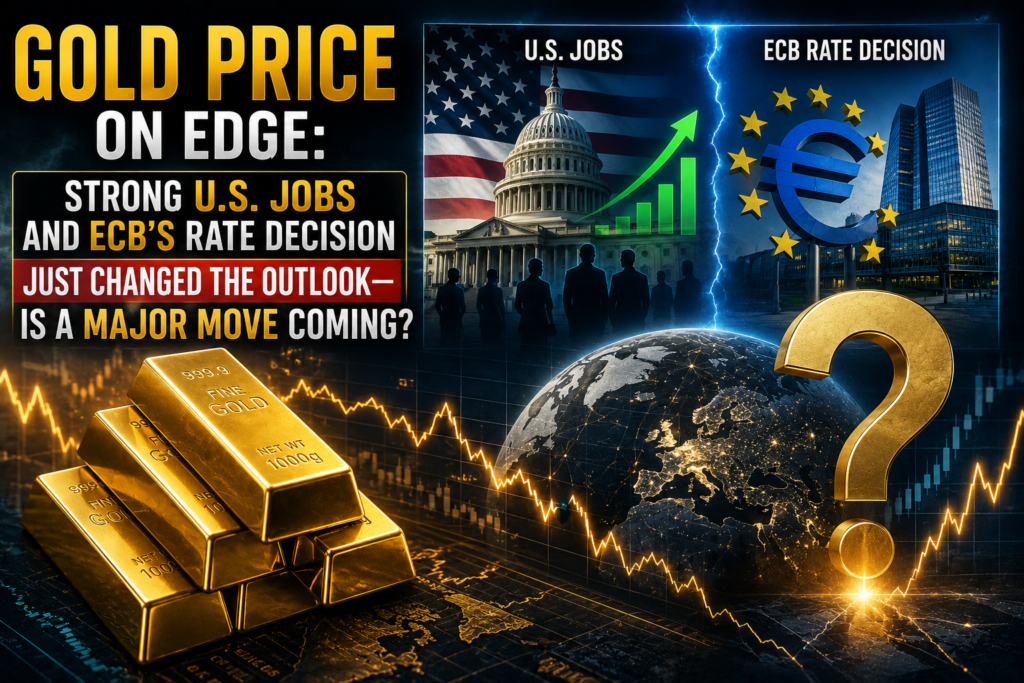
Gold Price on Edge: Strong U.S. Jobs and ECB’s Rate Decision Just Changed the Outlook—Is a Major Move Coming?
The global gold market has entered another pivotal moment.
Within a few hours, two of the world’s most influential economic events unfolded:
- 🇺🇸 U.S. Initial Jobless Claims unexpectedly dropped to 187,000, well below expectations of 210,000.
- 🇪🇺 The European Central Bank (ECB) kept its benchmark interest rate unchanged at 2.40%, signaling a cautious approach as inflation continues to moderate.
Individually, each event would attract market attention. Together, they have reshaped expectations for interest rates, currencies, and precious metals.
Gold investors are now asking one question:
Is this the beginning of gold’s next major move—or the start of a new correction?
Why the U.S. Jobless Claims Data Matters More Than You Think
The latest U.S. labor market data surprised economists.
| Indicator | Forecast | Previous | Actual |
|---|---|---|---|
| Initial Jobless Claims | 210K | 208K | 187K |
A reading of 187,000 suggests that the U.S. labor market remains remarkably resilient despite high interest rates.
For the Federal Reserve, a stronger labor market often means:
- Consumer spending remains healthy.
- Wage pressures may persist.
- Inflation risks do not disappear quickly.
- There is less urgency to cut interest rates.
This is important because gold performs best when investors expect lower interest rates.
If markets believe the Fed could delay rate cuts, Treasury yields and the U.S. dollar may stay firm, creating headwinds for gold.
The ECB Chose Stability Instead of Surprises
Across the Atlantic, the European Central Bank kept rates unchanged.
ECB Decision
| Rate | Current |
|---|---|
| Main Refinancing Rate | 2.40% |
| Deposit Facility Rate | 2.25% |
The decision matched market expectations.
Instead of signaling aggressive easing, policymakers emphasized patience while monitoring inflation and economic growth.
This cautious stance reduces the chances of major currency volatility in the euro—at least for now.
Why These Two Events Matter Together
Markets rarely react to a single headline.
Professional investors compare central bank policies across major economies.
Today’s combination tells a bigger story.
United States
✔ Strong labor market
✔ Higher-for-longer interest rate expectations
✔ Potential support for the U.S. dollar
Eurozone
✔ Rates unchanged
✔ Inflation improving
✔ Growth remains fragile
The result?
A stronger U.S. economic outlook relative to Europe could support the dollar.
Historically, a stronger dollar often places short-term pressure on gold because bullion is priced globally in U.S. dollars.
The Chain Reaction Investors Are Watching
Strong U.S. Jobs

↓

Fed Rate Expectations Stay High

↓

Treasury Yields Remain Elevated

↓

US Dollar Strengthens

↓

Gold Faces Selling Pressure
However, markets are rarely this simple.
Why Gold May Still Find Support
Despite stronger employment data, gold has several supportive factors that remain intact.
1. Central Banks Continue Buying Gold
Many central banks have steadily increased gold reserves over recent years as part of reserve diversification strategies.
This structural demand provides long-term support for bullion.
2. Geopolitical Risks Haven’t Disappeared
Ongoing geopolitical uncertainty continues to encourage some investors to maintain exposure to safe-haven assets like gold.
3. Inflation Isn’t Fully Defeated
Although inflation has eased from its peaks in many economies, it remains above target in several regions.
If inflation proves persistent, investor interest in gold as a portfolio diversifier could remain.
Three Scenarios for Gold
Scenario 1: Bullish
If upcoming inflation data softens and markets begin expecting Federal Reserve rate cuts again:
- Treasury yields could decline.
- The U.S. dollar could weaken.
- Gold may regain upward momentum.
Probability: Moderate
Scenario 2: Neutral
If economic data remains mixed:
- Gold could trade within a range.
- Investors may wait for clearer signals from central banks.
Probability: High
Scenario 3: Bearish
If additional economic reports continue to outperform expectations:
- Rate-cut expectations may be delayed.
- Bond yields could rise.
- Gold may experience short-term pressure.
Probability: Moderate
What Professional Investors Are Watching Next
Institutional investors are focusing on:
- Federal Reserve commentary.
- U.S. inflation reports.
- Treasury yield movements.
- Dollar Index (DXY).
- Gold ETF inflows and outflows.
- Geopolitical developments.
- Upcoming labor market data.
These factors often influence gold more than any single economic release.
What This Means for Gold Buyers
For long-term investors, short-term volatility is not unusual.
Those considering gold often look beyond daily price swings and evaluate:
- Portfolio diversification.
- Inflation protection.
- Long-term wealth preservation.
- Exposure to geopolitical risk.
Rather than reacting to one data point, many investors monitor broader economic trends before making allocation decisions.
Final Analysis
Today’s economic developments have created a more complex outlook for the gold market.
A stronger-than-expected U.S. labor market reinforces expectations that the Federal Reserve may remain cautious about lowering interest rates, while the ECB’s decision to hold rates steady reflects a wait-and-see approach in Europe.
Together, these events strengthen the case for continued volatility in gold rather than a one-way move.
The coming weeks will likely be shaped by inflation data, central bank communication, Treasury yields, and the U.S. dollar. Those factors—not today’s headlines alone—will determine whether gold resumes its broader uptrend or consolidates before its next significant move.
For investors, this is a reminder that the gold market responds not just to individual events, but to the interaction between growth, inflation, monetary policy, and global risk sentiment.
📌 Key Highlights
- 📉 U.S. Initial Jobless Claims fell to 187K, signaling a stronger labor market.
- 🏦 The ECB left its key interest rates unchanged, matching market expectations.
- 💵 Stronger U.S. data may support the dollar and influence gold in the short term.
- 🪙 Central bank demand and geopolitical uncertainty continue to provide longer-term support for gold.
- 📊 Investors are now focused on upcoming inflation data and Federal Reserve guidance.
❓FAQs
Why did gold react to U.S. jobless claims?
Lower-than-expected jobless claims suggest a resilient labor market, which can reduce expectations for near-term interest-rate cuts and affect gold prices.
Why does the ECB’s decision matter for gold?
The ECB influences the euro, global bond markets, and investor expectations, all of which can indirectly affect gold.
Is a stronger U.S. dollar bearish for gold?
Historically, a stronger dollar has often coincided with pressure on gold prices, though other factors such as geopolitical risk and central bank buying can offset that effect.
What should gold investors watch next?
Upcoming inflation reports, Federal Reserve communications, Treasury yields, the Dollar Index, and geopolitical developments are among the key indicators.
About GoldPriceNow
At GoldPriceNow, we deliver timely gold price updates, market analysis, investment insights, and global precious metals coverage to help readers understand the forces shaping the gold market. Whether you’re tracking daily prices or long-term trends, our goal is to provide clear, data-driven analysis for informed decision-making.
Related Articles
 Gold News
U.S. Treasury Doubles Bond Buybacks — Is Gold Getting a New Bullish Signal?
U.S. Treasury Doubles Bond Buybacks — Is Gold Getting a New Bullish Signal? The U.S. Treasury has just delivered a…
 Gold News
Gold Price Today Outlook as US Debt Crosses $40 Trillion and Treasury Yields Surge
Gold Price Today Outlook as US Debt Crosses $40 Trillion and Treasury Yields Surge The gold price today is facing…
 Investment Guides
Gold Price Today Outlook — US Jobs Data Could Decide Whether Gold Breaks Higher or Pulls Back
Gold Price Today Outlook — US Jobs Data Could Decide Whether Gold Breaks Higher or Pulls Back The gold price…