
Gold Is Near $4,400 as Hormuz Stays Blocked — Is the Next Move a Breakout or a Brutal Reversal?
August 16, 2026 · GoldPriceNow · 7 min read
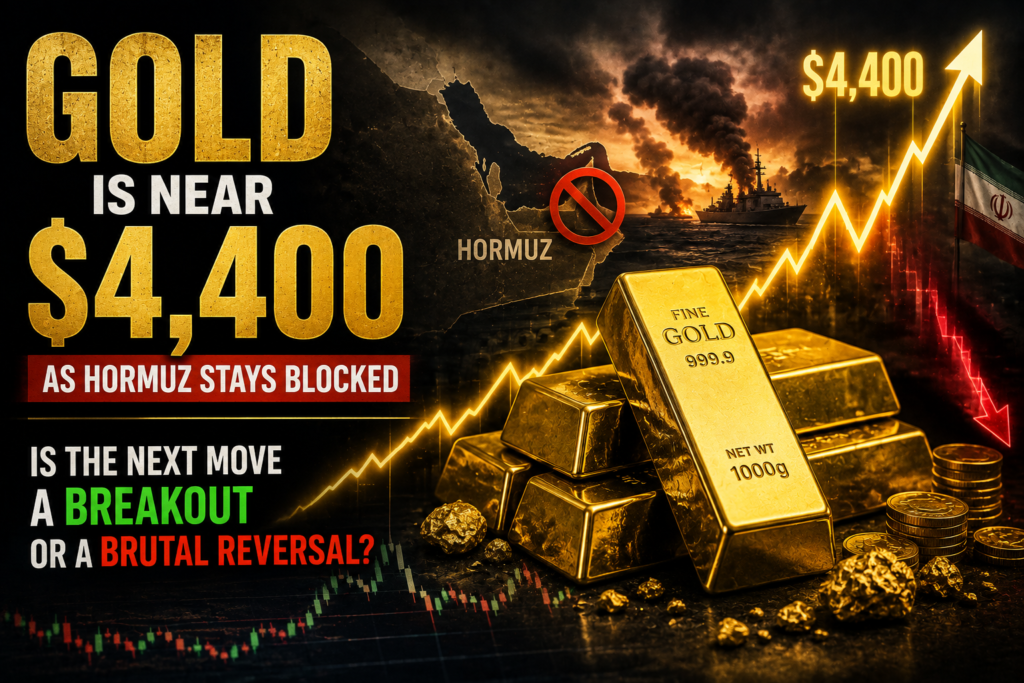
Gold Is Near $4,400 as Hormuz Stays Blocked — Is the Next Move a Breakout or a Brutal Reversal?
Gold is entering a critical zone as geopolitical risk, oil-market disruption and changing Federal Reserve expectations collide. The metal has recently traded around the $4,400-per-ounce area, while the Strait of Hormuz remains severely disrupted and U.S.-Iran tensions show little sign of an immediate resolution.
That creates a difficult setup for gold investors: the same geopolitical shock that supports safe-haven demand can also push oil and inflation higher, potentially keeping interest rates elevated and limiting gold’s upside.
The question for the week ahead is therefore not simply whether gold is bullish.
It is whether gold can break decisively above the $4,400-$4,450 region — or whether this rally has become vulnerable to a sharp profit-taking reversal.
Recent market coverage has placed gold above $4,400, while other reports show the metal experiencing strong gains during August.
Key Highlights
- Gold is trading around the $4,400 zone, a major psychological and technical area.
- The Strait of Hormuz remains severely disrupted, keeping geopolitical risk elevated.
- U.S.-Iran tensions remain unresolved, with peace negotiations stalled.
- Higher oil prices could create a double-edged effect for gold through inflation and interest-rate expectations.
- Softer U.S. inflation and weaker economic signals have recently reduced expectations for aggressive Fed tightening, supporting gold.
- Gold’s August rally has already been substantial, increasing the risk of profit-taking and short-term volatility.
- A sustained move above roughly $4,400-$4,450 could strengthen the bullish breakout case.
- Failure to hold the recent support zone could trigger a deeper correction toward the $4,300 area.
- Investors should watch the U.S. dollar, Treasury yields, crude oil, Fed expectations and Hormuz headlines alongside gold.
Why the Strait of Hormuz Matters for Gold
The Strait of Hormuz has become one of the most important variables for global markets.
The waterway is critical to international energy transportation, and the current conflict has dramatically reduced shipping activity. Reuters reported that commodity-vessel traffic through the strait had fallen well below normal levels, with only a handful of vessels passing through on some days.
The situation remained tense on August 16, with Reuters reporting that U.S.-Iran talks had stalled and tanker traffic remained disrupted. Brent crude was around $88.52 per barrel.
This matters for gold because oil affects inflation.
The chain reaction looks like this
Hormuz disruption → higher energy risk → inflation concerns → interest-rate uncertainty → higher volatility in gold
But there is another side.
Hormuz disruption → geopolitical uncertainty → safe-haven demand → increased demand for gold
These two forces can pull gold in opposite directions.
That is why the current environment is particularly important.
Gold Price Outlook Today
The latest market structure suggests that gold remains fundamentally supported, but the metal is approaching an area where breakout confirmation becomes extremely important.
Gold recently climbed to a two-month high, with Reuters reporting spot gold around $4,406.64 per ounce after U.S. inflation data reduced expectations for an imminent Federal Reserve rate hike.
Gold futures subsequently reached even higher levels, briefly moving above $4,500 in recent trading.
However, gold also experienced a sharp pullback on August 13, when COMEX gold settled at $4,363.60, down 1.03% on the day.
That is an important warning.
The market is showing both strong buying interest and aggressive profit-taking.
The $4,400 level is now the battlefield
A clean break and sustained hold above $4,400 would indicate that buyers are willing to absorb selling pressure at elevated prices.
But repeated failures around this zone would suggest that sellers are defending the area.
Gold price levels to watch
| Gold price zone | Market significance |
|---|---|
| $4,500+ | Major upside psychological target |
| $4,450-$4,500 | Breakout confirmation zone |
| $4,400-$4,450 | Major resistance / decision area |
| $4,350-$4,400 | Immediate trading range |
| $4,300-$4,350 | Important potential support |
| Below $4,300 | Bearish correction risk increases |
These are analytical reference levels, not guaranteed targets.
Bullish Gold Scenario
The strongest scenario for gold would involve several catalysts lining up simultaneously.
1. Gold breaks above $4,400
If gold can establish sustained trading above $4,400 rather than briefly spiking above it, momentum traders could return.
A move through $4,450 would make the breakout argument considerably stronger.
A move toward $4,500 could then become the next psychological objective.
2. Hormuz tensions remain unresolved
Continued disruption would maintain geopolitical uncertainty and support safe-haven demand.
Recent reporting indicates that the dispute remains unresolved, with Iran continuing to assert control over the waterway while Washington maintains pressure on Tehran.
3. The dollar weakens
Gold is priced primarily in U.S. dollars.
A weaker dollar generally makes gold cheaper for international buyers and can increase demand.
4. Fed rate-cut expectations strengthen
Gold does not pay interest.
Therefore, falling interest-rate expectations can reduce the opportunity cost of holding bullion.
Recent U.S. inflation data helped reduce expectations for an immediate rate increase, supporting gold.
Bearish Gold Scenario
The biggest danger for gold bulls is that the market has already priced in a large amount of geopolitical and monetary-policy optimism.
Gold has rallied sharply during August. MarketWatch reported that gold had gained more than 8% during the month by August 11, while other reporting showed the metal up around 9% over a two-week period.
That makes the market vulnerable to profit-taking.
What could trigger a reversal?
A stronger U.S. dollar
If investors suddenly seek dollars as a safe haven, gold could face pressure even while geopolitical tensions remain high.
Higher Treasury yields
Rising yields increase the opportunity cost of holding gold.
Oil-driven inflation
This is perhaps the most complicated risk.
A prolonged Hormuz disruption could push energy prices higher.
That could increase inflation expectations and potentially make the Federal Reserve more cautious about cutting rates.
In that scenario, gold could experience an unusual situation where geopolitical risk supports demand but higher yields limit the rally.
A diplomatic breakthrough
If the U.S. and Iran unexpectedly reach an agreement and shipping through Hormuz begins normalizing, some of the geopolitical premium in gold could disappear quickly.
That could produce a sharp correction.
The Biggest Gold Market Paradox Right Now
There is an important contradiction investors need to understand.
Normally:
Geopolitical crisis = bullish gold
But if the crisis causes:
oil prices ↑ → inflation ↑ → Fed becomes more hawkish → yields ↑ → dollar ↑
then the monetary reaction can become bearish for gold.
This is why simply saying “Hormuz is blocked, therefore gold must rise” is too simplistic.
Gold traders are effectively balancing safe-haven demand against interest-rate risk.
Could Gold Break $4,500?
Yes, but the market needs confirmation.
A brief move above $4,500 would not necessarily constitute a sustainable breakout.
The more convincing bullish signal would be:
$4,400 reclaimed → $4,450 cleared → $4,500 tested → price holds above the breakout zone
If that sequence develops while the dollar remains weak and Treasury yields stay contained, bullish momentum could strengthen.
Recent analyst commentary has suggested that gold could potentially move beyond $4,500 if inflation remains contained and expectations for rate hikes continue to fade.
Could Gold Crash Instead?
A “crash” is possible in the sense of a sharp correction, but the current information does not automatically imply a structural collapse.
The more realistic near-term bearish scenario would be a profit-taking correction.
For example:
$4,400 rejection → $4,350 → $4,300
If $4,300 fails decisively, traders could begin looking for a deeper retracement.
The key distinction is between:
- normal correction
- technical breakdown
- complete trend reversal
They are not the same thing.
What Investors Should Watch This Week
| Indicator | Bullish for Gold | Bearish for Gold |
|---|---|---|
| U.S. Dollar | Falling | Rising |
| Treasury yields | Falling | Rising |
| Fed rate expectations | More cuts | More hikes |
| Hormuz | Continued disruption | Rapid reopening |
| Oil | Geopolitical surge | Sharp decline |
| Inflation | Cooling | Accelerating |
| ETF flows | Strong inflows | Heavy outflows |
| Gold above $4,400 | Sustained | Rejected |
| Safe-haven demand | Increasing | Declining |
This combination is more useful than watching any single headline.
Gold’s Bigger Picture
Gold’s recovery is particularly notable because the metal was trading substantially lower earlier in the year.
Recent reporting shows that gold remains well below its January record area, meaning the current rally can still be viewed as a recovery rather than a complete return to its previous peak.
At the same time, renewed ETF demand is becoming an important supporting factor.
Business Insider reported that global gold-backed ETFs attracted approximately $3 billion in July, while holdings increased by about 23 metric tons to 4,068 tons.
That matters because sustained institutional investment can provide a more durable foundation than short-term geopolitical speculation.
Gold Price Forecast Scenarios
Bullish case
Above $4,450
If gold clears resistance and geopolitical tensions remain elevated, the market could target:
$4,500 → $4,580 → potentially higher
Neutral case
$4,300-$4,450
Gold could consolidate as investors wait for clarity on:
- Hormuz
- oil prices
- Fed policy
- U.S. economic data
- Treasury yields
Bearish case
Below $4,300
A decisive breakdown could open the door to a deeper correction as momentum traders lock in profits.
The critical point is that these are scenario levels, not predictions with certainty.
What Happens If Hormuz Reopens?
This could become the biggest bearish catalyst for gold.
If shipping normalizes quickly, investors could reduce geopolitical hedges.
Oil could fall.
Inflation expectations could ease.
Risk appetite could recover.
And some investors could rotate out of safe-haven assets.
That does not necessarily mean gold would collapse.
If lower oil prices simultaneously increase expectations for Fed easing, the monetary effect could offset some of the geopolitical selling.
This is precisely why the Fed + oil + dollar combination matters more than the Hormuz headline alone.
What Happens If Hormuz Remains Blocked?
This would keep the geopolitical premium alive.
However, the market would increasingly focus on whether the disruption causes:
- higher oil prices,
- higher inflation,
- higher Treasury yields,
- weaker global growth.
If the final outcome is higher inflation + weaker growth, gold could benefit from both safe-haven and economic-uncertainty demand.
But if it becomes higher inflation + sharply higher yields, gold could struggle to extend the rally despite the geopolitical crisis.
Gold Price View Note
Our current view is cautiously bullish above the $4,300-$4,350 area, but increasingly alert to reversal risk near $4,400-$4,500.
The strongest bullish signal would be a sustained breakout above $4,450 accompanied by a softer dollar and contained Treasury yields.
The strongest bearish signal would be repeated rejection around $4,400-$4,500 followed by a break below $4,300.
In other words:
Gold does not need another geopolitical headline to rally. It needs buyers to prove they can absorb selling near resistance.
That is the key question now.
FAQs
Is gold bullish near $4,400?
The broader short-term structure remains constructive, but $4,400-$4,500 is a high-risk resistance area. A confirmed breakout would strengthen the bullish outlook.
Why is the Strait of Hormuz important for gold?
The strait is crucial to global energy transportation. Disruption can increase geopolitical risk and oil-price uncertainty, both of which can influence gold.
Can higher oil prices push gold lower?
Yes. Higher oil can increase inflation expectations, potentially keeping interest rates and Treasury yields higher. That can pressure non-yielding gold.
Could gold reach $4,500?
A move above $4,500 is possible if momentum continues and macroeconomic conditions remain supportive. Recent market commentary has already identified $4,500 as a potential upside level.
What is the most important gold support level?
For this setup, the $4,300 area is an important reference point. A decisive break below it would weaken the immediate bullish structure.
What could cause gold to fall suddenly?
A combination of a stronger dollar, higher Treasury yields, reduced geopolitical risk, profit-taking and a hawkish shift in Federal Reserve expectations could trigger a sharp correction.
Is this a good time to buy gold?
That depends on investment horizon and risk tolerance. Investors should distinguish between buying physical gold for long-term diversification and trading XAU/USD around short-term resistance.
About GoldPriceNow
GoldPriceNow tracks gold prices, precious metals markets, gold price trends, economic events and market-moving developments across major currencies and markets.
For investors following the latest gold price today, gold price forecast, XAU/USD outlook, gold price per gram, gold price in USD, gold price in INR and global precious-metals trends, GoldPriceNow provides market-focused information designed to help readers understand what is driving the metal.
Use live pricing and the Gold Rate Calculator to estimate the value of gold by weight and purity before making purchasing decisions.
For broader financial-market news and breaking developments, visit The Business Now:
The Business Now
Note: GoldPriceNow market commentary is informational and should not be treated as personalized investment advice.
Key Resources
- Reuters — Gold and global markets
- Federal Reserve
- CME Group FedWatch
- World Gold Council
- MarketWatch Gold Markets
Recent reporting confirms that the Hormuz disruption remains a major market issue, while gold has been supported by both geopolitical uncertainty and changing expectations for U.S. monetary policy.
Related Articles
 Gold News
U.S. Treasury Doubles Bond Buybacks — Is Gold Getting a New Bullish Signal?
U.S. Treasury Doubles Bond Buybacks — Is Gold Getting a New Bullish Signal? The U.S. Treasury has just delivered a…
 Gold News
Gold Price Today Outlook as US Debt Crosses $40 Trillion and Treasury Yields Surge
Gold Price Today Outlook as US Debt Crosses $40 Trillion and Treasury Yields Surge The gold price today is facing…
 Investment Guides
Gold Price Today Outlook — US Jobs Data Could Decide Whether Gold Breaks Higher or Pulls Back
Gold Price Today Outlook — US Jobs Data Could Decide Whether Gold Breaks Higher or Pulls Back The gold price…