
Gold as an Inflation Hedge: Does It Still Work in 2026? What History and Data Reveal
July 20, 2026 · GoldPriceNow · 6 min read
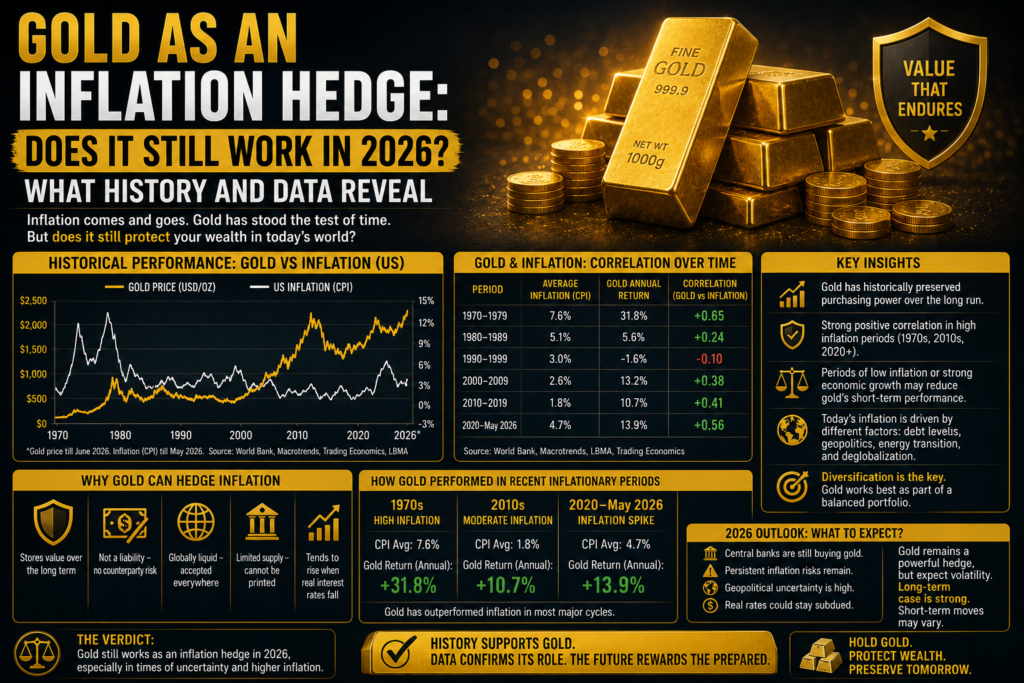
Gold as an Inflation Hedge: Does It Still Work in 2026? What History and Data Reveal
Inflation quietly reduces the purchasing power of money. As the cost of food, housing, healthcare, and everyday essentials rises, investors naturally look for assets that can help preserve wealth. For decades, gold has been viewed as one of the world’s most trusted inflation hedges.
But with today’s financial markets offering everything from Treasury Inflation-Protected Securities (TIPS) to cryptocurrencies and commodities, many investors are asking an important question:
Does gold still work as an inflation hedge in 2026?
The answer isn’t as simple as “yes” or “no.” Gold has historically helped protect purchasing power over long periods, but its short-term performance depends on several economic factors beyond inflation alone.
Why Inflation Matters to Investors
Inflation measures how quickly prices for goods and services increase over time.
For example:
| Inflation Rate | Purchasing Power After 10 Years |
|---|---|
| 2% | Around 82% of today’s value |
| 4% | Around 68% |
| 6% | Around 56% |
| 8% | Around 46% |
As inflation rises, cash loses value unless investments grow faster than inflation.
Why Gold Is Considered an Inflation Hedge
Unlike paper currencies, gold cannot be created by central banks.
Gold has several characteristics that make it attractive during inflationary periods:
- Limited global supply.
- Recognized worldwide.
- High liquidity.
- Long history as a store of value.
- Independent of any single country’s monetary policy.
These qualities have helped gold maintain purchasing power over long periods, although prices can fluctuate significantly in the short term.
How Gold Has Performed During Inflation
History shows that gold has often performed well during periods of elevated inflation, but the relationship is not always immediate.
| Economic Environment | Gold’s Historical Tendency |
|---|---|
| Rising Inflation | Often supportive |
| Falling Inflation | Mixed |
| High Interest Rates | Can create pressure |
| Lower Real Interest Rates | Often supportive |
| Economic Uncertainty | Frequently positive |
Gold reacts to a combination of inflation expectations, real interest rates, and investor sentiment—not inflation alone.
Why Gold Doesn’t Always Rise With Inflation
Many first-time investors assume:
Higher Inflation = Higher Gold Prices
Reality is more complicated.
Gold also responds to:
- Federal Reserve interest-rate decisions.
- U.S. dollar strength.
- Treasury yields.
- ETF inflows and outflows.
- Central bank buying.
- Geopolitical events.
If inflation rises but interest rates rise even faster, gold may face short-term pressure.
Real Interest Rates Matter More Than Many People Realize
Professional investors often pay close attention to real interest rates, which are interest rates adjusted for inflation.
When Real Rates Fall
- Gold generally becomes more attractive.
- Opportunity cost of holding gold decreases.
When Real Rates Rise
- Bonds may become relatively more attractive.
- Gold can face headwinds.
This is one reason why gold and inflation don’t always move together in the short run.
Central Banks Continue Supporting Gold
One of the strongest long-term themes in the gold market has been continued central bank demand.
Many central banks have diversified portions of their reserves into gold as part of broader reserve management strategies.
Institutional buying can provide long-term support independent of retail investment demand.
Gold vs Other Inflation Hedges
| Asset | Inflation Protection | Volatility | Income |
|---|---|---|---|
| Gold | High (Long Term) | Moderate | None |
| Stocks | Moderate | High | Dividends (some) |
| Real Estate | Moderate-High | Moderate | Rental Income |
| TIPS | Designed for inflation protection | Low | Interest |
| Cash | Low | Very Low | Low |
Each asset has different strengths, and many investors use a combination rather than relying on a single inflation hedge.
Advantages of Gold During Inflation
Wealth Preservation
Gold has maintained purchasing power across long periods of economic history.
Global Liquidity
Gold trades in markets around the world, making it one of the most liquid precious metals.
Diversification
Gold often behaves differently from stocks and bonds, making it a useful diversification tool.
Safe-Haven Appeal
Periods of economic or geopolitical uncertainty can increase investor demand for gold.
Risks Investors Should Remember
Gold also has limitations.
- It does not generate dividends or interest.
- Prices can fluctuate sharply.
- Performance may lag during strong equity bull markets.
- Short-term returns can differ significantly from inflation trends.
Understanding these trade-offs is essential before investing.
Should Investors Buy Gold During Inflation?
Gold may be appropriate for investors who:
- Want portfolio diversification.
- Seek a long-term store of value.
- Wish to reduce exposure to inflation risk.
- Prefer tangible assets alongside financial investments.
Rather than replacing stocks or bonds, gold is often used as one component of a diversified portfolio.
What Could Influence Gold for the Rest of 2026?
Several themes remain important:
- Federal Reserve interest-rate decisions.
- Inflation reports.
- U.S. dollar movements.
- Central bank gold purchases.
- Global geopolitical developments.
- Gold ETF investment flows.
Markets will continue evaluating how these factors interact rather than focusing on inflation alone.
Final Verdict
Does gold still work as an inflation hedge?
History suggests that gold has often helped preserve purchasing power over the long term, particularly during periods of elevated inflation and economic uncertainty.
However, gold should not be viewed as a perfect or guaranteed inflation hedge. Short-term performance depends on interest rates, currency movements, investor sentiment, and broader market conditions.
For many investors, gold’s greatest strength is not that it always rises during inflation—but that it can contribute to diversification and long-term wealth preservation within a balanced portfolio.
📊 Key Takeaways
| Factor | Gold’s Role |
|---|---|
| Inflation | Long-term hedge potential |
| Portfolio Diversification | Strong |
| Income Generation | None |
| Liquidity | Very High |
| Long-Term Wealth Preservation | High |
| Short-Term Volatility | Moderate |
⭐ Key Highlights
- 🪙 Gold has historically been viewed as a long-term hedge against inflation.
- 📈 Real interest rates often have a significant influence on gold prices.
- 🏦 Central bank demand remains an important long-term market driver.
- 🌍 Gold can diversify portfolios during periods of economic uncertainty.
- ⚖️ Gold is most effective when used as part of a balanced investment strategy rather than as a standalone solution.
❓FAQs
Is gold a good inflation hedge in 2026?
Gold continues to be widely used by investors seeking long-term protection against inflation and economic uncertainty, although short-term performance can vary.
Why doesn’t gold always rise when inflation increases?
Gold prices are influenced by multiple factors, including real interest rates, the U.S. dollar, central bank activity, and investor sentiment.
Is gold better than cash during inflation?
Cash provides stability and liquidity, but inflation can reduce its purchasing power over time. Gold is often used by investors looking for a long-term store of value.
Should I buy physical gold or Gold ETFs for inflation protection?
Both can provide exposure to gold. Physical gold offers direct ownership, while Gold ETFs provide convenience and liquidity. The best choice depends on your investment goals.
Can gold protect against every economic crisis?
No asset offers complete protection. Gold can play an important role in diversification, but it should generally be considered alongside other investments.
About GoldPriceNow
GoldPriceNow delivers trusted coverage of gold prices, silver rates, precious metals news, investment analysis, market trends, and global economic developments. Whether you’re tracking daily gold prices or researching long-term investment strategies, GoldPriceNow provides timely insights to help you make informed financial decisions.
External Authority Sources
Related Articles
 Gold News
U.S. Treasury Doubles Bond Buybacks — Is Gold Getting a New Bullish Signal?
U.S. Treasury Doubles Bond Buybacks — Is Gold Getting a New Bullish Signal? The U.S. Treasury has just delivered a…
 Gold News
Gold Price Today Outlook as US Debt Crosses $40 Trillion and Treasury Yields Surge
Gold Price Today Outlook as US Debt Crosses $40 Trillion and Treasury Yields Surge The gold price today is facing…
 Investment Guides
Gold Price Today Outlook — US Jobs Data Could Decide Whether Gold Breaks Higher or Pulls Back
Gold Price Today Outlook — US Jobs Data Could Decide Whether Gold Breaks Higher or Pulls Back The gold price…