
Gold Is Rising Across the World’s Biggest Currencies—Is This the Global Wealth Shift Investors Have Been Waiting For?
July 24, 2026 · GoldPriceNow · 3 min read
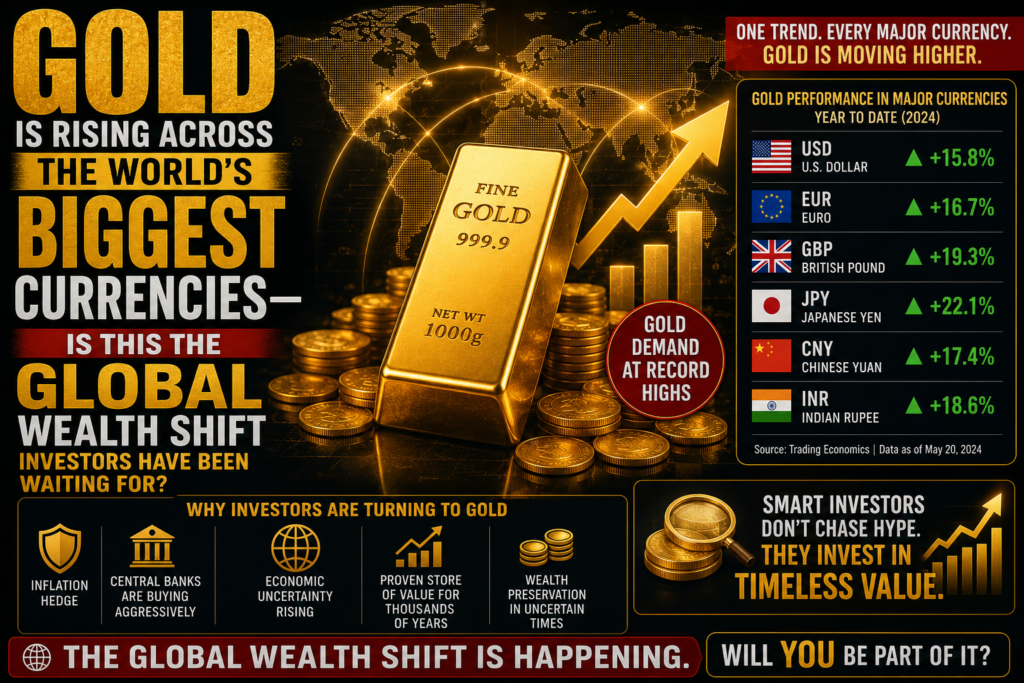
Gold Is Rising Across the World’s Biggest Currencies—Is This the Global Wealth Shift Investors Have Been Waiting For?
For years, investors have tracked gold primarily in U.S. dollars. But something more significant may be unfolding. Gold is showing strength across multiple major currencies simultaneously—from the U.S. dollar and euro to the British pound, Swiss franc, Canadian dollar, Chinese yuan, and Japanese yen.
When gold gains value across several currencies at the same time, it can indicate more than a simple price move. It may reflect a broader search for stability as investors respond to inflation concerns, geopolitical uncertainty, central-bank policies, and changing currency expectations.
Live Global Gold Prices
| Currency | 1 Gram Gold | Daily Move |
|---|---|---|
| 🇺🇸 US Dollar (USD) | $130.57 | ▲0.28% |
| 🇪🇺 Euro (EUR) | €114.68 | ▲0.21% |
| 🇬🇧 British Pound (GBP) | £97.99 | ▲0.24% |
| 🇨🇭 Swiss Franc (CHF) | CHF106.64 | ▲0.30% |
| 🇦🇺 Australian Dollar (AUD) | A$186.73 | ▼0.07% |
| 🇨🇦 Canadian Dollar (CAD) | CA$183.87 | ▲0.28% |
| 🇨🇳 Chinese Yuan (CNY) | CN¥884.03 | ▲0.26% |
| 🇮🇳 Indian Rupee (INR) | ₹12,603.83 | ▼0.07% |
| 🇯🇵 Japanese Yen (JPY) | ¥21,384.94 | ▲0.25% |
The broad pattern is notable: gold is strengthening in most major currencies rather than relying on weakness in a single one.
Why This Matters More Than a Normal Gold Rally
Most daily gold moves are driven by the U.S. dollar. A stronger dollar often pressures gold, while a weaker dollar can support it.
This time, however, gold is demonstrating resilience across multiple currency pairs. That suggests investors are responding to wider macroeconomic themes rather than a single exchange-rate move.
Some of the factors that can contribute include:
- Central-bank diversification of reserves.
- Persistent geopolitical uncertainty.
- Inflation expectations.
- Questions about future interest-rate paths.
- Demand for portfolio diversification.
When these influences converge, gold often attracts attention from institutions as well as retail investors.
The Global Wealth Shift
A noticeable trend over recent years has been the increasing role of central banks in gold markets.
Many monetary authorities have expanded their gold holdings as part of reserve diversification strategies. Gold carries no issuer risk and has historically served as a reserve asset during periods of financial stress.
While reserve management differs by country, the broader trend has contributed to continued interest in physical gold.
Gold Is Moving Beyond Just the U.S. Dollar
Looking only at dollar-denominated gold can miss part of the story.
Gold’s performance in:
- Euro
- Pound Sterling
- Swiss Franc
- Canadian Dollar
- Chinese Yuan
- Japanese Yen
helps reveal whether demand is broad-based.
When multiple currency charts show similar strength, analysts often interpret it as evidence of widespread investor demand rather than a localized move.
Inflation Still Matters
Although inflation has eased from peak levels in several economies, many households continue to face elevated living costs.
Historically, investors have used gold as one component of a diversified portfolio during periods of:
- Currency depreciation
- Inflation uncertainty
- Declining real interest rates
- Financial-market volatility
Gold does not guarantee protection, but its historical role explains why demand often rises during uncertain periods.
Geopolitical Risk Continues to Influence Markets
Global events remain an important driver of precious-metal markets.
Investors monitor developments involving:
- Middle East tensions
- Global trade disputes
- Energy-market disruptions
- Supply-chain risks
- Election-related uncertainty
- Regional conflicts
Periods of heightened uncertainty often increase demand for assets viewed as stores of value.
Why Professional Investors Watch Gold in Multiple Currencies
Institutional investors rarely analyze only one chart.
They often compare:
- Gold in USD
- Gold in EUR
- Gold in GBP
- Gold in CHF
- Gold in JPY
This helps determine whether price strength is broad or limited to a single currency environment.
Broad participation generally provides a stronger signal than isolated moves.
What Could Drive Gold Higher—or Lower?
Potential bullish factors
- Increased central-bank purchases.
- Softer monetary policy.
- Persistent geopolitical uncertainty.
- Strong physical demand.
- Continued ETF inflows.
Potential headwinds
- Higher real interest rates.
- A stronger U.S. dollar.
- Reduced geopolitical tensions.
- Slower investment demand.
- Profit-taking after sharp rallies.
What Should Investors Watch Next?
Rather than focusing only on today’s price, investors may want to monitor:
- U.S. inflation releases.
- Federal Reserve guidance.
- European Central Bank decisions.
- Central-bank reserve reports.
- Gold ETF flows.
- Dollar Index (DXY).
- Real Treasury yields.
- Physical demand from Asia.
These factors often shape medium-term trends more than daily headlines.
Global Gold Snapshot
| Indicator | Current View |
|---|---|
| Multi-currency trend | Broadly positive |
| Central-bank demand | Supportive |
| Inflation outlook | Still relevant |
| Geopolitical backdrop | Elevated uncertainty |
| Long-term investor interest | Remains solid |
Final Analysis
The latest price data suggests that gold’s strength is not confined to one market or one currency. Instead, it reflects demand from investors operating across different regions and monetary systems.
That does not guarantee a major rally or imply that prices can only move higher. Gold remains sensitive to interest rates, currency movements, and investor sentiment.
However, when gold performs well across multiple major currencies at the same time, it can indicate that market participants are looking beyond short-term fluctuations and focusing on longer-term preservation of purchasing power.
Whether this marks the beginning of a broader wealth shift will depend on upcoming economic data, central-bank actions, and geopolitical developments—but it is a trend that investors are watching closely.
FAQs
Why is gold rising in multiple currencies?
Because demand appears to be broad-based rather than driven solely by changes in the U.S. dollar. Global macroeconomic factors, central-bank activity, and geopolitical uncertainty can all contribute.
Does this mean gold will continue to rise?
No. Gold prices are influenced by many variables, including interest rates, inflation, currency movements, and market sentiment. Past performance and current trends do not guarantee future returns.
Why do institutions track gold in different currencies?
Comparing gold across currencies helps determine whether demand is widespread or limited to a specific market.
Which economic indicators matter most for gold?
Investors commonly monitor inflation, central-bank policy, real interest rates, the U.S. dollar, ETF flows, and geopolitical developments.
Is gold still considered a long-term portfolio asset?
Many investors include gold as part of a diversified portfolio because of its historical role during periods of uncertainty, though allocations vary depending on individual objectives.
About GoldPriceNow
At GoldPriceNow, we provide global gold price updates, precious-metals market analysis, central-bank insights, economic news, and practical tools to help investors track gold markets across major countries and currencies. Whether you’re following daily prices or long-term trends, our goal is to deliver clear, data-driven coverage for a global audience.
Related Articles
 Gold News
U.S. Treasury Doubles Bond Buybacks — Is Gold Getting a New Bullish Signal?
U.S. Treasury Doubles Bond Buybacks — Is Gold Getting a New Bullish Signal? The U.S. Treasury has just delivered a…
 Gold News
Gold Price Today Outlook as US Debt Crosses $40 Trillion and Treasury Yields Surge
Gold Price Today Outlook as US Debt Crosses $40 Trillion and Treasury Yields Surge The gold price today is facing…
 Investment Guides
Gold Price Today Outlook — US Jobs Data Could Decide Whether Gold Breaks Higher or Pulls Back
Gold Price Today Outlook — US Jobs Data Could Decide Whether Gold Breaks Higher or Pulls Back The gold price…