
Before You Buy Gold Today, Read This First: 10 Factors Every Investor Should Know in 2026
July 20, 2026 · GoldPriceNow · 6 min read
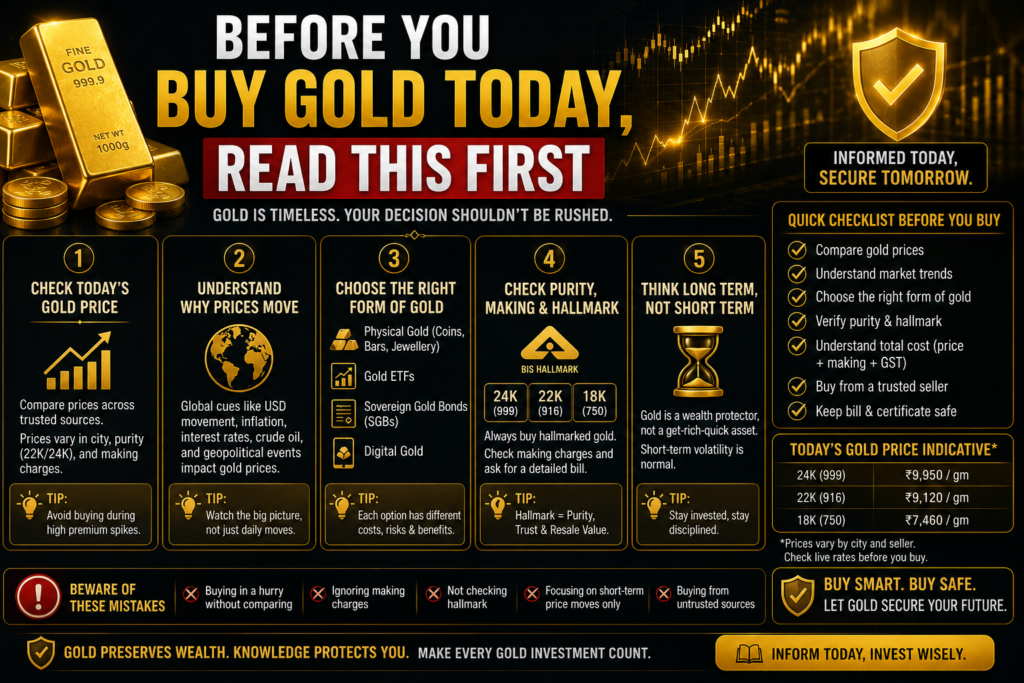
Before You Buy Gold Today, Read This First: 10 Factors Every Investor Should Know in 2026
Gold has always been seen as a symbol of wealth and financial security. Yet buying gold simply because prices are rising—or because everyone else is talking about it—can lead to poor investment decisions.
In 2026, gold continues to trade near historically elevated levels as investors weigh inflation, central bank policy, geopolitical uncertainty, and global economic growth. Before making any purchase, it’s worth understanding what actually drives gold prices and how gold fits into a diversified investment strategy.
This guide explains the key factors every investor should consider before buying gold today.
Why Gold Is Back in the Spotlight
Interest in gold often increases when uncertainty rises. Recent years have brought inflation concerns, changing interest-rate expectations, geopolitical events, and significant central bank demand for gold reserves.
At the same time, gold remains popular among investors seeking diversification rather than relying solely on stocks or bonds.
1. Don’t Buy Gold Based Only on Headlines
Strong headlines can make it seem like gold will only move in one direction. In reality, gold prices fluctuate every day.
Before investing, ask:
- What is driving today’s price movement?
- Is the move based on economic data?
- Are markets reacting to central bank decisions?
- Has investor sentiment changed?
Understanding the reason behind the move is often more valuable than reacting to the headline itself.
2. Interest Rates Matter More Than Many Investors Realize
One of the biggest influences on gold is monetary policy.
When interest rates rise, income-producing assets such as bonds may become relatively more attractive because gold does not generate interest or dividends.
When markets expect lower rates, gold can become more appealing as the opportunity cost of holding it decreases.
3. Inflation Still Influences Gold
Gold is often viewed as a long-term store of value.
Many investors use it as part of a strategy to help preserve purchasing power when inflation remains elevated, although gold’s short-term performance can vary.
Rather than focusing on one inflation report, consider the broader economic trend.
4. The U.S. Dollar Plays a Major Role
Gold is traded globally in U.S. dollars.
Historically:
| Dollar Trend | Possible Gold Impact |
|---|---|
| Stronger Dollar | Can create pressure on gold prices |
| Weaker Dollar | May support gold demand |
The relationship is not perfect, but currency movements remain one of the market’s most closely watched indicators.
5. Central Banks Continue Buying Gold
Central banks remain significant participants in the gold market.
Their purchases are often viewed as a sign that gold continues to play an important role in reserve management and portfolio diversification.
Long-term institutional demand has been one factor supporting the market in recent years.
6. Decide What Type of Gold You Want
Not every gold investment is the same.
| Investment | Best For |
|---|---|
| Physical Gold | Long-term ownership |
| Gold ETFs | Easy investing and liquidity |
| Gold Mining Stocks | Growth potential with higher risk |
| Gold Mutual Funds | Diversified exposure |
Your choice should reflect your financial goals, investment horizon, and risk tolerance.
7. Don’t Ignore Costs
The purchase price is only part of the total cost.
Physical Gold
Possible additional expenses include:
- Dealer premiums
- Storage
- Insurance
Gold ETFs
Potential costs may include:
- Brokerage commissions
- Fund expense ratios
Comparing total costs can help investors make more informed decisions.
8. Gold Is Not Guaranteed to Rise
Gold has experienced both long periods of gains and periods of declines.
Like any investment, prices respond to changing economic conditions, investor sentiment, and market expectations.
Viewing gold as a long-term component of a diversified portfolio may be more effective than expecting consistent short-term gains.
9. Diversification Can Reduce Risk
Many professional investors avoid concentrating their portfolios in a single asset.
Instead, they combine:
- Stocks
- Bonds
- Gold
- Cash
- Other investments
Gold can contribute to diversification, but it is generally used alongside other assets rather than replacing them.
10. Timing Isn’t Everything
Trying to buy at the exact market bottom is difficult.
Some investors choose to invest gradually over time rather than making a single large purchase, helping reduce the impact of short-term price swings.
Gold Investment Checklist
Before buying gold today, consider these questions:
| Question | Why It Matters |
|---|---|
| Why am I buying gold? | Clarifies your investment objective |
| What is my investment horizon? | Influences the type of gold to consider |
| Do I need liquidity? | May affect whether physical gold or ETFs are suitable |
| Have I considered total costs? | Helps avoid unexpected expenses |
| Does gold fit my portfolio? | Supports diversification rather than concentration |
Common Mistakes Investors Make
- Buying based solely on market excitement.
- Ignoring fees and storage costs.
- Investing without understanding risk.
- Expecting gold to always outperform other assets.
- Concentrating too much of a portfolio in a single investment.
Avoiding these mistakes can help investors make more balanced decisions.
Outlook
Gold’s future direction will continue to depend on:
- Inflation trends.
- Federal Reserve policy.
- Interest rates.
- Central bank buying.
- Currency movements.
- Global economic conditions.
Rather than reacting to daily price changes, investors may benefit from evaluating how gold supports their broader financial objectives.
Final Thoughts
Buying gold should be based on research rather than emotion.
Gold remains one of the world’s most recognized investment assets, valued for diversification, liquidity, and its long history as a store of value. However, like any investment, it carries risks and should be considered within the context of a balanced portfolio.
Understanding why you are buying gold—and how it fits your long-term goals—may be more important than trying to predict tomorrow’s price movement.
📌 Key Highlights
- 🪙 Gold remains a widely used diversification asset.
- 📈 Interest rates, inflation, and the U.S. dollar are major price drivers.
- 🏦 Central bank demand continues to support the gold market.
- 💼 Physical gold, ETFs, and mining stocks each have different characteristics.
- ⚖️ Successful investing focuses on strategy, diversification, and long-term planning.
❓FAQs
Is now a good time to buy gold?
The answer depends on your financial goals, time horizon, and overall portfolio. Gold may play a role in diversification, but no investment is guaranteed to rise.
Should I buy physical gold or a Gold ETF?
Physical gold provides direct ownership, while Gold ETFs offer convenience and liquidity. The right choice depends on your preferences and investment objectives.
Why do gold prices change every day?
Gold prices are influenced by factors including interest rates, inflation, currency movements, investor demand, and global economic events.
How much gold should be in a portfolio?
There is no universal allocation. Investors should consider their goals, risk tolerance, and overall asset mix when deciding how much exposure to gold is appropriate.
What is the biggest mistake new gold investors make?
One common mistake is buying based solely on headlines or fear of missing out instead of understanding the reasons behind market movements.
About GoldPriceNow
GoldPriceNow delivers trusted coverage of gold prices, silver rates, precious metals news, investment analysis, market trends, and global economic developments. Whether you’re tracking daily gold prices or researching long-term investment strategies, GoldPriceNow provides timely insights to help you make informed financial decisions.
External Authority Sources
Related Articles
 Gold News
U.S. Treasury Doubles Bond Buybacks — Is Gold Getting a New Bullish Signal?
U.S. Treasury Doubles Bond Buybacks — Is Gold Getting a New Bullish Signal? The U.S. Treasury has just delivered a…
 Gold News
Gold Price Today Outlook as US Debt Crosses $40 Trillion and Treasury Yields Surge
Gold Price Today Outlook as US Debt Crosses $40 Trillion and Treasury Yields Surge The gold price today is facing…
 Investment Guides
Gold Price Today Outlook — US Jobs Data Could Decide Whether Gold Breaks Higher or Pulls Back
Gold Price Today Outlook — US Jobs Data Could Decide Whether Gold Breaks Higher or Pulls Back The gold price…