
Gold Price Now Faces a New Shock as Oil Falls and the Strait of Hormuz Could Reopen
August 4, 2026 · GoldPriceNow · 3 min read
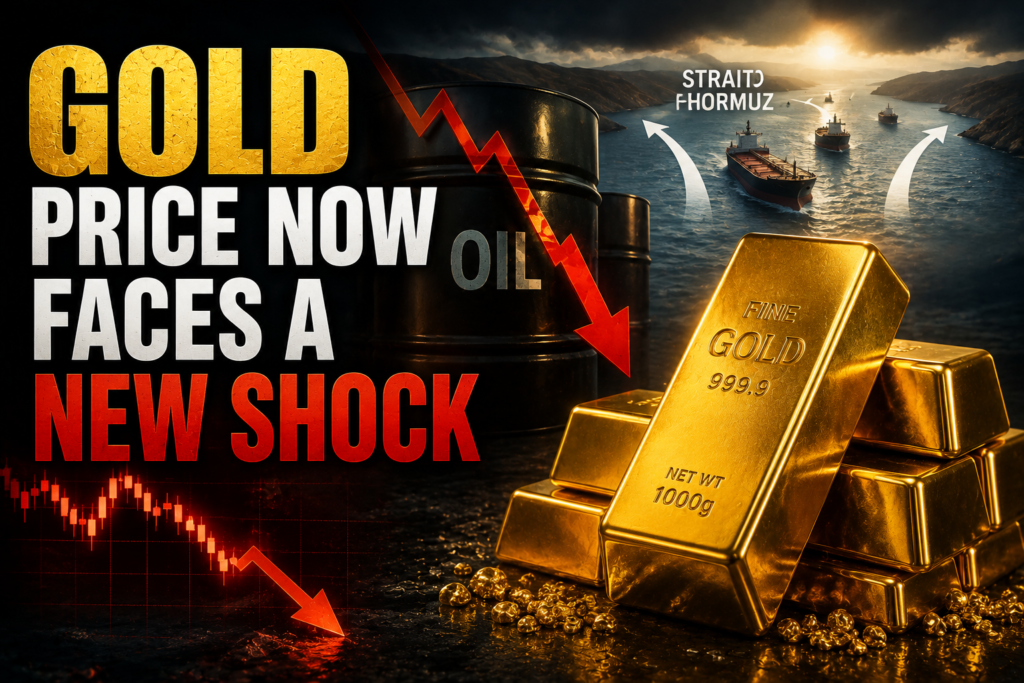
Gold Price Now Faces a New Shock as Oil Falls and the Strait of Hormuz Could Reopen
Gold is entering another high-volatility phase as expectations of a possible Strait of Hormuz reopening push crude oil prices lower. For gold investors, the big question is whether falling oil reduces geopolitical risk enough to pressure bullion—or whether lingering uncertainty keeps safe-haven demand alive.
The latest market headlines are pulling two powerful forces in opposite directions.
On one side, Brent crude is moving closer to the $80-per-barrel level, according to the market alert shown in the supplied screenshot. On the other, expectations are building around a possible reopening of the Strait of Hormuz, one of the world’s most important energy routes. Recent reporting says negotiations around restoring shipping through the strait are ongoing.
That combination could create an important setup for gold price today.
Gold Price Today Faces a Two-Way Battle
Gold is particularly sensitive to changes in:
- Geopolitical risk
- U.S. interest-rate expectations
- Inflation expectations
- The U.S. dollar
- Treasury yields
- Oil prices
- Safe-haven demand
- Global economic growth
The latest market move is therefore more complicated than simply saying “oil down, gold down.”
Gold was recently trading around $4,038 per ounce, according to a market report published today, while Brent crude had fallen sharply.
That divergence is important.
If investors believe the Middle East situation is genuinely moving toward de-escalation, some money could rotate away from traditional safe-haven assets. But if reopening expectations remain uncertain, investors may continue holding gold as insurance against another geopolitical shock.
Why the Strait of Hormuz Matters for Gold
The Strait of Hormuz is a critical chokepoint for global energy markets.
The IMF has previously estimated that roughly 20 million barrels of oil per day, equivalent to about 20% of global daily oil consumption, normally pass through the strait.
That makes any major disruption extremely important for:
Oil → Inflation → Interest rates → Bond yields → Dollar → Gold
A disruption can push energy prices higher, potentially increasing inflation expectations.
A successful reopening could have the opposite effect.
The potential chain reaction
| Development | Possible Market Effect | Potential Gold Impact |
|---|---|---|
| Hormuz reopening | Geopolitical risk falls | Bearish |
| Oil prices fall | Inflation pressure eases | Potentially bearish |
| Inflation expectations decline | Rate-cut expectations may change | Mixed |
| Treasury yields fall | Gold becomes relatively attractive | Bullish |
| Dollar weakens | Gold becomes cheaper for non-dollar buyers | Bullish |
| Middle East uncertainty remains | Safe-haven demand stays | Bullish |
| Shipping disruption returns | Oil and risk premiums rise | Potentially bullish |
This is why gold price prediction today cannot be based on oil alone.
Gold Price and Oil Are Now Sending an Important Signal
The supplied market alert shows Brent crude approaching the $80-per-barrel area as expectations of Hormuz reopening increase.
Recent market coverage also reported that oil prices had fallen sharply amid hopes of de-escalation, while gold remained relatively firm.
That could indicate that investors are not completely abandoning defensive assets.
Instead, markets may be moving from a panic hedge toward a monetary and macroeconomic hedge.
That distinction matters.
Gold does not only rise during wars. It can also benefit from expectations of lower real interest rates, currency weakness, inflation uncertainty and concerns about economic growth.
The Biggest Question for Gold Investors
The key question now is:
Is the Hormuz story actually ending, or is the market simply pricing in the possibility of an improvement?
Those are very different situations.
A headline saying the strait could reopen is not the same as normal shipping activity being fully restored.
The BIS has warned that even after reopening, uncertainty around the resumption of traffic and the backlog of vessels could keep physical energy markets tight for some time.
That means the market could remain extremely headline-sensitive.
Scenario 1 — Hormuz Reopens and Oil Falls Further
This would probably be the most bearish scenario for short-term gold sentiment.
If shipping normalizes:
- Oil risk premium could decline
- Inflation fears could ease
- Geopolitical risk could fall
- Equity markets could strengthen
- Safe-haven demand could soften
That could trigger a gold pullback.
However, the decline may not necessarily become a major crash.
Why?
Because gold still has other drivers, particularly monetary policy, the dollar and real yields.
Scenario 2 — Reopening Is Delayed
This could be a much more bullish environment for gold.
If negotiations fail or shipping remains disrupted, markets could quickly refocus on:
- Energy supply risks
- Higher transportation costs
- Inflation
- Geopolitical uncertainty
- Global economic disruption
That could bring safe-haven buyers back into gold.
A renewed oil spike could therefore create another wave of volatility across precious metals.
Scenario 3 — Oil Falls but Gold Refuses to Follow
This is arguably the most interesting scenario.
If crude continues falling while gold remains firm, it would suggest that investors are buying gold for reasons beyond immediate geopolitical protection.
Potential drivers include:
Lower real yields + central-bank demand + currency concerns + portfolio diversification + economic uncertainty.
Today’s market action therefore deserves attention even if gold does not immediately break higher.
What Gold Price Today Could Do Next
The near-term outlook is likely to remain headline-driven.
Bullish gold setup
Gold could regain momentum if:
- Hormuz reopening talks fail
- Oil rebounds sharply
- Geopolitical tensions increase
- The U.S. dollar weakens
- Treasury yields decline
- Markets increase expectations for easier monetary policy
Bearish gold setup
Gold could come under pressure if:
- Hormuz fully reopens
- Oil continues falling
- Geopolitical risk premium disappears
- U.S. yields rise
- The dollar strengthens
- Investors rotate aggressively into risk assets
Neutral/consolidation setup
Gold could remain range-bound if oil falls but geopolitical uncertainty does not disappear completely.
That is currently an important possibility. A market report today described gold as steady while Middle East negotiations weighed on the interest-rate outlook.
Why Falling Oil Does Not Automatically Mean Falling Gold
This is one of the most important points for readers following Gold Price Now.
Gold and crude oil can react differently to the same geopolitical event.
For example:
Oil:
Reopening → more expected supply → lower risk premium → lower price
Gold:
Reopening → lower geopolitical risk → lower safe-haven demand
That initially sounds bearish for both.
But if lower oil subsequently produces:
Lower inflation → lower interest rates → lower real yields
gold could regain support.
Therefore, traders need to watch the second-order effects, not just the first headline.
What to Watch Before the Next Gold Move
For anyone tracking gold price today, these are the most important market signals.
| Indicator | Bullish for Gold | Bearish for Gold |
|---|---|---|
| U.S. Dollar | Weakens | Strengthens |
| Treasury Yields | Fall | Rise |
| Real Yields | Fall | Rise |
| Oil | Sharp rebound | Continued decline |
| Hormuz | Renewed disruption | Full reopening |
| Geopolitical Risk | Increases | Declines |
| Fed Expectations | More dovish | More hawkish |
| Inflation Risk | Rises unexpectedly | Falls significantly |
The most important combination would be falling yields + weaker dollar + persistent geopolitical uncertainty.
That could create a powerful tailwind for bullion.
Is Gold Still a Safe-Haven Asset?
Yes, but investors should understand that safe haven does not mean guaranteed upside.
Gold can decline even during geopolitical uncertainty if the U.S. dollar and Treasury yields rise sharply.
Likewise, gold can rise when geopolitical tensions are easing if monetary-policy expectations become sufficiently supportive.
That is why professional gold analysis usually looks at several variables simultaneously.
Gold Price Outlook for the Coming Sessions
The next few trading sessions could be particularly volatile.
The market is effectively watching two stories at once:
Story 1 — De-escalation
Hormuz reopening → oil falls → inflation pressure eases → risk appetite improves
This could initially weigh on gold.
Story 2 — Monetary uncertainty
Economic uncertainty → lower yields/rate expectations → gold demand
This could support gold.
The winner between these two forces will likely determine the next major gold move.
The Bottom Line for Gold Price Now
The latest Hormuz headlines have created a fascinating setup for gold price today.
Oil moving toward the $80 area suggests that markets are beginning to price in reduced energy-supply risk, while expectations of a reopening are encouraging investors to reassess geopolitical exposure.
But gold remaining relatively firm is a reminder that bullion has multiple drivers.
If Hormuz genuinely reopens and oil continues falling, gold could face short-term profit-taking. If reopening hopes fade, the safe-haven bid could return quickly.
For gold traders, the most important signal may therefore not be oil itself—but what the dollar, Treasury yields and gold do after the oil shock fades.
That is where the next major gold trend could emerge.
Frequently Asked Questions
Is falling oil bearish for gold?
Not necessarily. Lower oil can reduce inflation and geopolitical risk, which may initially pressure gold. However, if lower energy prices lead to expectations of lower interest rates or weaker real yields, gold can receive renewed support.
Why does the Strait of Hormuz affect gold prices?
Hormuz is a major global energy chokepoint. Any disruption can affect oil prices, inflation expectations and global risk sentiment, all of which can influence gold.
Could gold fall if Hormuz reopens?
Yes. A confirmed reopening could reduce geopolitical risk and safe-haven demand, potentially triggering a short-term gold correction.
Could gold still rise if oil prices fall?
Yes. Gold can respond positively to falling Treasury yields, a weaker dollar, monetary-policy expectations and broader economic uncertainty even when oil is declining.
What should gold investors watch next?
Watch U.S. Treasury yields, the dollar index, oil prices, Fed expectations and developments around Hormuz.
About Gold Price Now
Gold Price Now is designed to help readers follow gold prices, precious-metal markets, economic events and market-moving developments in one place. The platform covers gold price today, gold price forecasts, gold investment themes, precious metals and global economic news.
For live rates and market analysis, follow Gold Price Now throughout the trading week.
Read More
For broader business, markets and economic coverage, visit The Business Now.
Sources and further reading
IMF — World Economic Outlook
BIS — Annual Economic Report 2026
The Business Times — Gold and Hormuz developments
Moneycontrol — Hormuz reopening and oil markets
Related Articles
 Gold News
U.S. Treasury Doubles Bond Buybacks — Is Gold Getting a New Bullish Signal?
U.S. Treasury Doubles Bond Buybacks — Is Gold Getting a New Bullish Signal? The U.S. Treasury has just delivered a…
 Gold News
Gold Price Today Outlook as US Debt Crosses $40 Trillion and Treasury Yields Surge
Gold Price Today Outlook as US Debt Crosses $40 Trillion and Treasury Yields Surge The gold price today is facing…
 Investment Guides
Gold Price Today Outlook — US Jobs Data Could Decide Whether Gold Breaks Higher or Pulls Back
Gold Price Today Outlook — US Jobs Data Could Decide Whether Gold Breaks Higher or Pulls Back The gold price…