
The Hidden Indicator That Has Predicted Every Major Gold Rally for the Last 30 Years
July 23, 2026 · GoldPriceNow · 3 min read
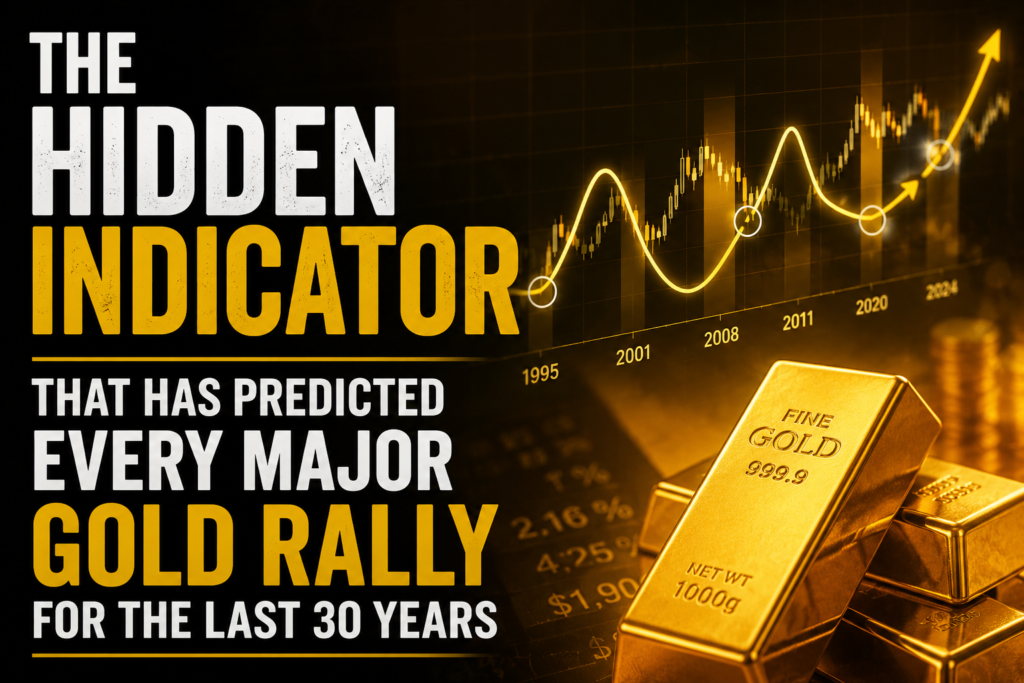
The Hidden Indicator That Has Predicted Every Major Gold Rally for the Last 30 Years
Every day, millions of investors check the price of gold.
Very few ask the more important question:
What actually causes gold to begin a major rally?
Most people blame inflation.
Others point to wars.
Some focus on central bank buying.
While all of these factors can influence gold, history suggests there is one indicator that has repeatedly aligned with many of the metal’s biggest advances over the past three decades.
It isn’t the stock market.
It isn’t oil.
It isn’t even inflation alone.
It’s real interest rates—the difference between nominal interest rates and inflation.
For professional investors, this metric often provides a clearer picture of the environment in which gold has historically performed well.
What Are Real Interest Rates?
A simple formula explains it.
Real Interest Rate = Nominal Interest Rate − Inflation Rate
Example:
Federal Funds Rate: 5%
Inflation: 3%
Real Interest Rate:
2%
Now imagine inflation rises to 6% while rates remain 5%.
Real interest rates become:
–1%
Even though nominal rates haven’t changed, the purchasing power of money has declined.
This is one reason why investors may reassess the role of assets such as gold.
Why Gold Responds to Real Rates
Gold doesn’t generate interest or dividends.
When investors can earn attractive inflation-adjusted returns from bonds or cash, gold can become relatively less attractive.
However, when inflation outpaces interest rates—or when real yields fall—gold has often attracted greater investor attention.
In simple terms:
Lower or negative real rates can reduce the opportunity cost of holding gold.
The Pattern Behind Many Gold Bull Markets
While no single indicator predicts markets with certainty, several major gold advances occurred during periods when real yields were declining or deeply negative.
| Period | Gold Trend | Real Rate Environment |
|---|---|---|
| Early 2000s | Strong multi-year advance | Falling real yields |
| 2008–2011 | Major rally | Low/negative real rates amid financial crisis |
| 2020 | Sharp rally | Deeply negative real rates |
| Recent years | Renewed strength | Expectations of lower real yields as inflation and policy evolve |
The relationship is not perfect, but it has been one of the most closely watched indicators among institutional investors.
Why Inflation Alone Isn’t Enough
Many investors assume:
Higher inflation = Higher gold.
Reality is more nuanced.
Imagine inflation reaches 8%, but central banks raise interest rates to 10%.
Real rates remain positive.
In that environment, gold may not respond as strongly as some expect because investors are still earning positive inflation-adjusted returns elsewhere.
The key is not inflation alone—but the balance between inflation and interest rates.
The Five Signals Professionals Watch
Rather than relying on one headline, many portfolio managers monitor several indicators together:
1. Real Interest Rates
Often considered one of the most important macroeconomic inputs for gold.
2. U.S. Dollar
Gold is generally priced in dollars.
A stronger dollar can create headwinds, while a weaker dollar has often coincided with stronger gold performance.
3. Central Bank Gold Purchases
Many central banks continue to diversify reserves with gold.
Sustained official-sector buying can support long-term demand.
4. Gold ETF Flows
Inflows into gold-backed exchange-traded funds may indicate rising investor interest.
5. Geopolitical Risk
Periods of uncertainty can increase demand for assets viewed as stores of value.
Why This Indicator Matters More Today
Today’s market combines several powerful forces:
- Inflation has moderated from previous highs but remains closely watched.
- Central banks continue to evaluate interest-rate policy.
- Government debt levels remain elevated in many economies.
- Geopolitical tensions continue to influence investor sentiment.
- Central banks remain active participants in the gold market.
As a result, investors are paying close attention to where real interest rates are headed—not just where they are today.
A Simple Example
Imagine two economies.
Economy A
- Inflation: 2%
- Interest Rates: 5%
- Real Rate: +3%
Economy B
- Inflation: 5%
- Interest Rates: 3%
- Real Rate: –2%
Both economies have different inflation numbers, but Economy B has negative real rates.
Historically, that type of environment has often been more supportive for gold than Economy A.
What Could Change the Outlook?
Several developments could influence real interest rates and, in turn, gold:
- Inflation surprising to the upside.
- Faster-than-expected interest-rate cuts.
- Slower global economic growth.
- Changes in Treasury yields.
- Currency movements.
- Shifts in investor expectations.
None of these guarantees a gold rally, but together they shape the environment in which gold trades.
Is This Indicator Perfect?
No.
Markets are influenced by many variables.
Gold can also respond to:
- Currency fluctuations.
- Financial stress.
- Central bank buying.
- ETF demand.
- Geopolitical events.
- Supply and demand dynamics.
Real interest rates should therefore be viewed as one important indicator—not a standalone prediction tool.
Final Analysis
For decades, investors have searched for a reliable way to understand gold’s biggest moves.
History suggests that one of the most informative indicators has been the direction of real interest rates.
When inflation-adjusted returns on traditional assets decline, the opportunity cost of holding gold can fall, making the metal more attractive to many investors.
That does not mean every decline in real rates leads to a gold rally, or that every rally can be explained by this factor alone.
But when combined with central bank activity, the U.S. dollar, ETF flows, inflation expectations, and geopolitical developments, real interest rates remain one of the most valuable tools for interpreting the gold market.
For investors looking beyond daily price swings, understanding this relationship may provide a more meaningful framework than watching headlines alone.
📌 Key Highlights
- 📉 Real interest rates have historically aligned with many major gold rallies.
- 🪙 Gold often becomes more attractive when inflation-adjusted yields decline.
- 💵 The U.S. dollar, Treasury yields, and central bank buying remain key market drivers.
- 🌍 Gold is influenced by a combination of macroeconomic and geopolitical factors.
- 📊 Professional investors typically evaluate multiple indicators rather than relying on a single signal.
❓FAQs
What are real interest rates?
Real interest rates measure the return on an investment after adjusting for inflation. They are calculated by subtracting the inflation rate from the nominal interest rate.
Why do real interest rates matter for gold?
Lower or negative real interest rates can reduce the opportunity cost of holding non-yielding assets such as gold, although many other factors also influence prices.
Is inflation alone enough to predict gold prices?
Not necessarily. The interaction between inflation, interest rates, the U.S. dollar, investor demand, and geopolitical developments all contribute to gold’s performance.
What other indicators should investors monitor?
Many investors also watch Treasury yields, the Dollar Index (DXY), central bank gold purchases, gold ETF flows, and global economic conditions.
About GoldPriceNow
GoldPriceNow provides daily gold price updates, precious metals analysis, market insights, and educational content to help investors understand the economic forces shaping gold and other precious metals.
Stay Updated with TheBusinessNow.in
Looking beyond precious metals? TheBusinessNow.in delivers the latest business news, stock market updates, global economy insights, technology trends, and in-depth financial analysis to keep investors informed about the markets that matter.
Related Articles
 Gold News
U.S. Treasury Doubles Bond Buybacks — Is Gold Getting a New Bullish Signal?
U.S. Treasury Doubles Bond Buybacks — Is Gold Getting a New Bullish Signal? The U.S. Treasury has just delivered a…
 Gold News
Gold Price Today Outlook as US Debt Crosses $40 Trillion and Treasury Yields Surge
Gold Price Today Outlook as US Debt Crosses $40 Trillion and Treasury Yields Surge The gold price today is facing…
 Investment Guides
Gold Price Today Outlook — US Jobs Data Could Decide Whether Gold Breaks Higher or Pulls Back
Gold Price Today Outlook — US Jobs Data Could Decide Whether Gold Breaks Higher or Pulls Back The gold price…