
Brent Crude Hits $100: Is This the Warning Signal That Gold Investors Can’t Afford to Ignore?
July 23, 2026 · GoldPriceNow · 3 min read
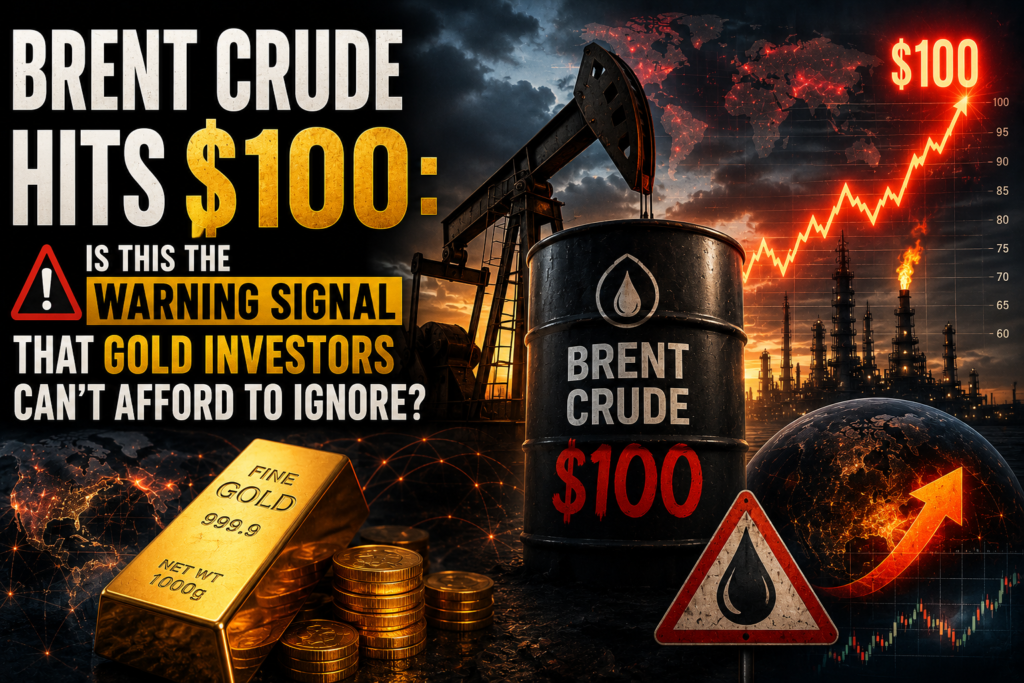
Brent Crude Hits $100: Is This the Warning Signal That Gold Investors Can’t Afford to Ignore?
For months, investors have been focused on interest rates, inflation, and central bank policy. Now another variable has moved sharply back into focus: oil.
Reports that Brent crude has reached the $100-per-barrel level amid supply concerns and geopolitical tensions have renewed questions about what higher energy prices could mean for inflation, economic growth, and the global gold market.
Historically, sharp increases in oil prices have often influenced inflation expectations and financial markets. While oil alone does not determine gold prices, it can become an important part of the broader picture that investors watch.
So, does a move toward $100 oil automatically mean gold will rally?
Not necessarily—but it is a development worth watching.
Why the $100 Oil Level Matters
Oil is one of the world’s most important commodities.
A sustained move toward or above $100 per barrel can affect:
- Transportation costs.
- Manufacturing expenses.
- Airline and shipping costs.
- Consumer fuel prices.
- Inflation expectations.
- Corporate profit margins.
Because energy is used across almost every industry, higher oil prices can ripple through the economy.
Why Oil and Gold Are Connected
Oil and gold do not always move in the same direction.
However, they are linked through several economic channels.
Higher Oil Prices
↓
Higher production and transportation costs
↓
Potential inflation pressures
↓
Greater uncertainty about interest rates
↓
Changes in investor demand for safe-haven assets
↓
Possible impact on gold prices
This relationship depends on how central banks respond and how markets interpret the broader economic outlook.
What’s Driving Oil Higher?
Several factors can contribute to rising crude prices, including:
1. Geopolitical Tensions
Concerns over shipping routes, regional conflicts, or supply disruptions can affect market expectations for oil availability.
Even if physical supply remains adequate, uncertainty alone can increase price volatility.
2. Supply Constraints
Lower production, unexpected outages, or tighter inventories can reduce available supply and support higher prices.
3. Strong Seasonal Demand
Periods of increased travel or industrial activity can also contribute to stronger oil demand.
Why Gold Investors Are Paying Attention
Gold reacts to more than just oil.
Professional investors monitor several interconnected variables.
Inflation
Higher energy costs can contribute to broader inflation.
Gold has historically been viewed by many investors as a portfolio diversifier during periods of elevated inflation, although its performance varies depending on the broader economic environment.
Federal Reserve Policy
If rising oil contributes to persistent inflation, policymakers may be slower to reduce interest rates.
Higher interest rates can weigh on gold because the metal does not generate income.
Safe-Haven Demand
Periods of geopolitical uncertainty sometimes increase demand for assets perceived as stores of value, including gold.
The Dollar Could Become the Deciding Factor
One of the most important relationships for gold remains the U.S. dollar.
If higher oil prices strengthen inflation expectations and keep U.S. interest rates elevated:
- Treasury yields could remain high.
- The U.S. dollar could stay firm.
- Gold may face short-term pressure.
On the other hand, if higher oil prices begin to slow economic growth and increase financial uncertainty:
- Investors may seek diversification.
- Demand for gold could strengthen.
- Safe-haven buying may offset pressure from interest rates.
Lessons From Previous Oil Shocks
History shows that the relationship between oil and gold is not always straightforward.
| Period | Oil Trend | Gold Reaction |
|---|---|---|
| 1970s oil shocks | Oil surged | Gold also rose significantly amid high inflation. |
| 2008 commodity boom | Oil climbed sharply | Gold strengthened before the financial crisis intensified. |
| 2022 energy disruption | Oil prices spiked | Gold experienced periods of increased volatility alongside changing interest-rate expectations. |
These examples illustrate that the broader macroeconomic context matters as much as the oil price itself.
Three Scenarios for Gold
Scenario 1: Inflation Persists
If oil remains elevated and inflation proves difficult to reduce:
- Central banks may remain cautious.
- Interest rates could stay higher for longer.
- Gold’s performance would depend on whether safe-haven demand outweighs pressure from higher yields.
Scenario 2: Geopolitical Risks Increase
If supply concerns expand into broader market uncertainty:
- Investors could increase allocations to defensive assets.
- Gold may benefit from stronger safe-haven demand.
Scenario 3: Oil Retreats
If supply conditions improve and oil prices decline:
- Inflation expectations could ease.
- Markets may refocus on growth and monetary policy.
- Gold would likely take its direction from interest-rate expectations and the U.S. dollar rather than oil alone.
Indicators Gold Investors Should Watch
Rather than focusing only on the oil price, experienced investors often monitor:
- Brent crude prices.
- WTI crude prices.
- U.S. inflation data.
- Federal Reserve statements.
- Treasury yields.
- Dollar Index (DXY).
- Central bank gold purchases.
- Gold ETF flows.
- Major geopolitical developments.
These indicators together provide a more complete picture of the forces influencing gold.
Could This Be the Start of Gold’s Next Big Move?
A move toward $100 oil is significant because it has the potential to influence inflation expectations, monetary policy, and investor sentiment simultaneously.
Whether that translates into higher gold prices will depend on how those broader forces evolve over the coming weeks.
Gold rarely responds to a single headline. Instead, it reflects the balance between inflation, interest rates, economic growth, currency movements, and global uncertainty.
Final Analysis
Brent crude approaching or reaching $100 per barrel has put another important variable back on investors’ radar.
Higher oil prices can affect inflation expectations and central bank decisions, while geopolitical tensions may increase interest in safe-haven assets such as gold.
At the same time, stronger inflation could also support higher interest rates and a firmer U.S. dollar—factors that have historically created headwinds for gold.
For that reason, the next major move in the gold market is likely to depend not just on oil, but on how inflation, Federal Reserve policy, the dollar, and geopolitical developments interact.
The current environment reinforces a familiar lesson for investors: major commodity markets are deeply interconnected, and understanding those relationships is often more valuable than reacting to a single headline.
📌 Key Highlights
- 🛢️ Brent crude has moved toward the $100-per-barrel level, drawing attention across financial markets.
- 📈 Higher oil prices can influence inflation expectations and central bank policy.
- 🪙 Gold may benefit from increased safe-haven demand if uncertainty rises, but higher interest rates can also create headwinds.
- 💵 The U.S. dollar and Treasury yields remain key variables for gold investors.
- 🌍 Monitoring oil, inflation, interest rates, and geopolitical developments together provides a clearer view of the gold market.
❓FAQs
Why does the oil price matter for gold?
Higher oil prices can affect inflation, monetary policy expectations, and investor sentiment, all of which can influence gold.
Does $100 oil guarantee higher gold prices?
No. Gold is influenced by multiple factors, including interest rates, the U.S. dollar, central bank actions, and geopolitical risks.
What should investors watch next?
Upcoming inflation reports, Federal Reserve communications, Treasury yields, the Dollar Index, and developments affecting global energy markets.
Is gold still considered a safe-haven asset?
Many investors continue to use gold as part of a diversified portfolio during periods of uncertainty, though its performance can vary depending on market conditions.
About GoldPriceNow
GoldPriceNow provides daily gold price updates, precious metals analysis, macroeconomic insights, and market education for investors around the world. Our goal is to explain not just where gold prices are moving, but why.
Related Articles
 Gold News
U.S. Treasury Doubles Bond Buybacks — Is Gold Getting a New Bullish Signal?
U.S. Treasury Doubles Bond Buybacks — Is Gold Getting a New Bullish Signal? The U.S. Treasury has just delivered a…
 Gold News
Gold Price Today Outlook as US Debt Crosses $40 Trillion and Treasury Yields Surge
Gold Price Today Outlook as US Debt Crosses $40 Trillion and Treasury Yields Surge The gold price today is facing…
 Investment Guides
Gold Price Today Outlook — US Jobs Data Could Decide Whether Gold Breaks Higher or Pulls Back
Gold Price Today Outlook — US Jobs Data Could Decide Whether Gold Breaks Higher or Pulls Back The gold price…