
Trump Wants to Open Fort Knox After Decades: Could America’s Biggest Gold Audit Shake the Global Gold Market?
July 22, 2026 · GoldPriceNow · 3 min read
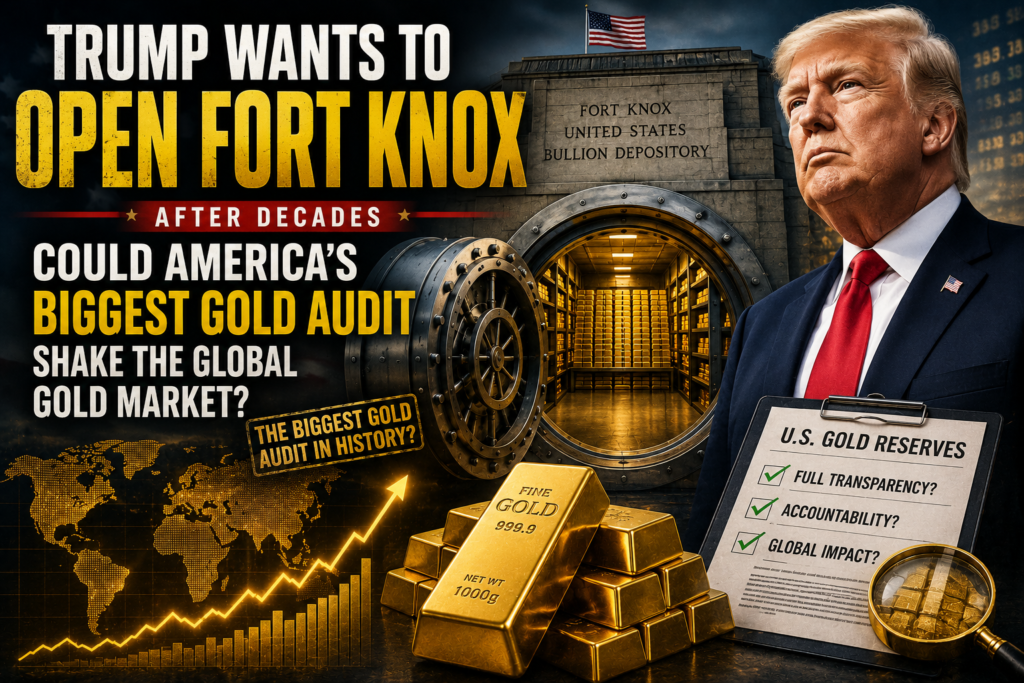
Trump Wants to Open Fort Knox After Decades: Could America’s Biggest Gold Audit Shake the Global Gold Market?
For decades, Fort Knox has been surrounded by mystery, conspiracy theories, and public curiosity.
Now, former U.S. President Donald Trump has once again drawn attention to America’s legendary gold vault by saying he wants the facility opened and its gold reserves inspected.
The announcement has reignited a question that has fascinated investors for generations:
Is all of America’s gold really inside Fort Knox?
If a comprehensive inspection were to take place, it would become one of the most closely watched events in modern financial history—not because anyone expects dramatic surprises, but because Fort Knox symbolizes confidence in the U.S. financial system.
For the global gold market, perception can be almost as important as reality.
What Is Fort Knox?
Fort Knox is officially known as the United States Bullion Depository.
Located in Fort Knox, Kentucky, about 35 miles (56 km) south of Louisville, it was built in 1936, and the first shipments of gold arrived in 1937.
Unlike the nearby military base, the Bullion Depository is operated by the U.S. Mint, which is part of the U.S. Department of the Treasury.
Its primary role is to securely store a significant portion of the United States’ official gold reserves.
How Much Gold Is Stored Inside?
According to the U.S. Mint, Fort Knox currently stores approximately:
- 147.3 million fine troy ounces of gold
- Around 4,580 metric tonnes (about 4,500+ metric tons)
- Roughly half of all U.S. Treasury-owned gold reserves
At today’s gold prices, the market value of these holdings would be measured in hundreds of billions of U.S. dollars, although official accounting values are calculated differently.
This makes Fort Knox one of the largest official gold storage facilities in the world.
Why Is Fort Knox So Famous?
Fort Knox has become a global symbol of security because very few people have ever entered the vault.
Public access is almost nonexistent, and only a handful of official inspections have taken place over the decades.
That secrecy has fueled countless books, documentaries, and conspiracy theories questioning whether all the gold is still there.
Despite those rumors, the U.S. Treasury has consistently stated that the gold remains accounted for.
How Is Fort Knox Protected?
Fort Knox is widely regarded as one of the most secure facilities in the world.
Its security includes:
- Reinforced granite and concrete construction.
- A massive steel vault door.
- Advanced surveillance systems.
- Electronic security layers.
- Controlled access procedures.
- Armed security personnel.
- Protection from the nearby U.S. Army installation.
According to the U.S. Mint, no single individual knows every procedure required to open the vault, with security responsibilities divided among multiple authorized personnel.
This layered approach is designed to minimize operational risk and unauthorized access.
Why Does Trump Want to Inspect Fort Knox?
Donald Trump has publicly stated that he wants to verify that America’s reported gold reserves are physically present.
His comments have revived public interest in a facility that many Americans know by name but know little about.
Supporters argue that an inspection could:
- Increase transparency.
- Reassure taxpayers.
- Address long-standing public speculation.
- Demonstrate confidence in official reserve reporting.
No official findings have suggested that the reported reserves are missing, and there has been no announcement of a formal nationwide gold recount beyond public statements calling for greater transparency.
Why Hasn’t Fort Knox Been Opened Regularly?
The gold inside Fort Knox is not actively traded.
It serves primarily as part of the nation’s official reserve assets.
Because the bullion is intended for long-term storage rather than commercial use, routine public inspections have not been a regular practice.
Although government audits and verification procedures occur, public access to the vault has remained extremely limited.
Could an Inspection Affect Gold Prices?
The inspection itself would not automatically change gold prices.
However, financial markets pay close attention to confidence.
Scenario 1: Gold Holdings Match Official Records
If an inspection confirms the reported holdings, it could reinforce confidence in U.S. reserve management.
The immediate market impact might be limited because investors generally assume the reported reserves are accurate.
Scenario 2: Unexpected Findings (Hypothetical)
If a significant discrepancy were ever discovered—a hypothetical scenario rather than an expected outcome—markets could react sharply.
Potential consequences might include:
- Increased market volatility.
- Greater demand for safe-haven assets.
- Reassessment of reserve confidence.
- Stronger investor interest in physical gold.
It is important to note that there is no official evidence suggesting such a discrepancy exists.
Would America Buy More Gold?
Social media has circulated claims that the United States would purchase additional gold if reserves were found to be lower than reported.
At present:
- No official U.S. government policy has announced such a plan.
- There has been no formal commitment to buy gold based on a future inspection.
If policymakers ever decided to increase official gold reserves, such a decision could influence global gold demand—but that remains speculative and should not be treated as current policy.
Why the Entire World Is Watching
Fort Knox is more than a vault.
It represents confidence in one of the world’s largest official gold reserve holdings.
For investors, this story touches on several themes:
- Trust in reserve reporting.
- Central bank credibility.
- Global monetary stability.
- Safe-haven demand.
- Long-term confidence in gold.
Even without dramatic discoveries, renewed public attention on Fort Knox could increase interest in gold investing and precious-metals markets.
What This Means for Gold Investors
Professional investors are likely to continue focusing on the broader drivers of gold prices:
- Federal Reserve policy.
- Inflation expectations.
- Treasury yields.
- U.S. dollar strength.
- Central bank purchases.
- Geopolitical developments.
Any discussion about Fort Knox adds an additional layer of public interest, but long-term price trends will still depend on these fundamental market forces.
Final Analysis
Trump’s renewed calls to inspect Fort Knox have brought one of America’s most iconic financial institutions back into the spotlight.
Whether or not a high-profile inspection takes place, the discussion highlights the enduring importance of gold in the global financial system.
Fort Knox is not simply a vault—it is a symbol of national reserves, monetary confidence, and the role gold continues to play in an increasingly uncertain world.
If a comprehensive inspection is conducted and confirms the reported reserves, it may strengthen confidence rather than dramatically alter the market. If future policy discussions were ever to include changes to U.S. gold reserves, investors would watch closely—but any such outcome would depend on official decisions, not speculation.
📌 Key Highlights
- 🏦 Fort Knox stores approximately 4,580 metric tonnes of U.S. Treasury gold.
- 🇺🇸 The depository is located in Kentucky and has protected U.S. gold reserves since 1937.
- 🔐 It is regarded as one of the most secure bullion storage facilities in the world.
- 🪙 Donald Trump has renewed calls for a public inspection of the vault.
- 📈 Markets are watching because confidence in official reserves can influence investor sentiment toward gold.
❓FAQs
Where is Fort Knox located?
Fort Knox is located in Kentucky, approximately 35 miles south of Louisville, and houses the United States Bullion Depository.
How much gold is stored in Fort Knox?
According to the U.S. Mint, Fort Knox stores about 147.3 million fine troy ounces, or roughly 4,580 metric tonnes, of gold.
Why is Fort Knox important?
It contains a significant portion of the United States’ official gold reserves and is a symbol of financial stability and national wealth.
Has Fort Knox been opened for public inspections?
Public access has been extremely limited over the decades. While official verification procedures exist, public tours are not permitted.
Will an inspection automatically increase gold prices?
Not necessarily. Gold prices are influenced by many factors, including interest rates, inflation, central bank policies, currency movements, and investor sentiment. An inspection could affect market confidence, but its impact would depend on the findings and broader economic conditions.
Related Articles
 Gold News
U.S. Treasury Doubles Bond Buybacks — Is Gold Getting a New Bullish Signal?
U.S. Treasury Doubles Bond Buybacks — Is Gold Getting a New Bullish Signal? The U.S. Treasury has just delivered a…
 Gold News
Gold Price Today Outlook as US Debt Crosses $40 Trillion and Treasury Yields Surge
Gold Price Today Outlook as US Debt Crosses $40 Trillion and Treasury Yields Surge The gold price today is facing…
 Investment Guides
Gold Price Today Outlook — US Jobs Data Could Decide Whether Gold Breaks Higher or Pulls Back
Gold Price Today Outlook — US Jobs Data Could Decide Whether Gold Breaks Higher or Pulls Back The gold price…