
Gold Price Alert: Iran’s New Threats and Surprise U.S. Oil Data—Is Gold About to Make Its Biggest Move This Month?
July 22, 2026 · GoldPriceNow · 5 min read
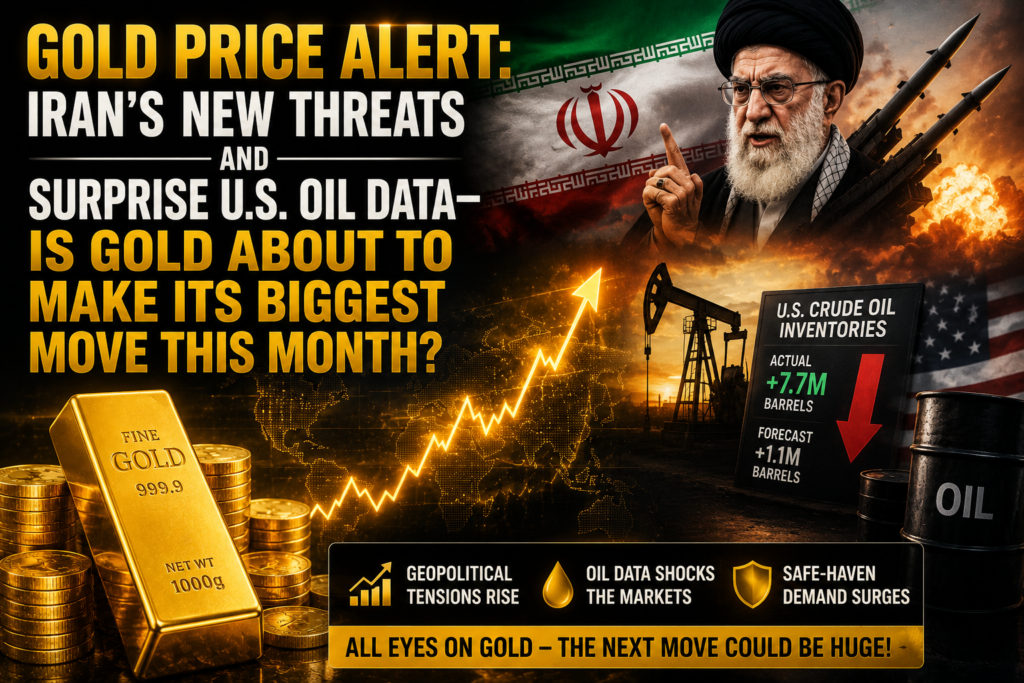
Gold Price Alert: Iran’s New Threats and Surprise U.S. Oil Data—Is Gold About to Make Its Biggest Move This Month?
Global financial markets are once again shifting into risk-monitoring mode after three significant developments emerged within hours of each other:
- Iran warned it could target regional energy facilities if attacked.
- Iran also warned of possible retaliation against U.S.-linked infrastructure if military action occurs.
- U.S. crude oil inventories unexpectedly surged, surprising energy markets.
Individually, each event can influence investor sentiment. Together, they have the potential to reshape expectations across oil, inflation, currencies, and gold.
The key question investors are asking is:
Could these developments trigger the next major move in gold prices?
Why Gold Investors Are Watching the Middle East Again
Gold has long been viewed as a defensive asset during periods of geopolitical uncertainty.
The latest statements from Iran have renewed market attention because any escalation involving regional energy infrastructure could affect:
- Oil production
- Energy supply chains
- Shipping routes
- Inflation expectations
- Global investor confidence
Markets are not pricing in outcomes—they are reassessing risk probabilities.
The Oil Story May Be More Important Than the Headlines
At the same time, U.S. crude oil inventory data showed a much larger-than-expected increase.
According to the figures you shared:
- Previous: -1.692 million barrels
- Forecast: -0.880 million barrels
- Actual: +2.010 million barrels
Normally, a larger inventory build can indicate softer short-term demand or higher supply, which may place downward pressure on oil prices.
However, geopolitical developments can offset inventory data if markets begin pricing in potential supply disruptions.
This creates a complex environment where traders weigh current supply against future risks.
Why This Matters for Gold
Gold does not respond to a single headline.
Instead, investors evaluate several interconnected factors:
Scenario 1: Geopolitical Risk Increases
If tensions escalate further:
- Safe-haven demand could strengthen.
- Market volatility may increase.
- Investors may allocate more toward defensive assets such as gold.
Scenario 2: Oil Prices Become More Volatile
Energy markets influence inflation expectations.
If concerns about supply disruptions outweigh the inventory increase, oil prices could rise, affecting broader inflation expectations and potentially supporting gold.
Scenario 3: Markets Focus on Economic Data
If investors conclude that inventory levels reduce immediate supply concerns, attention may shift back to:
- Federal Reserve policy
- Treasury yields
- The U.S. dollar
- Inflation data
These remain important drivers of gold prices.
The Chain Reaction Investors Are Watching
Iran Warnings

↓

Energy Market Uncertainty

↓

Oil Price Volatility

↓

Inflation Expectations

↓

Federal Reserve Outlook

↓

Treasury Yields

↓

US Dollar

↓

Gold Prices
Gold’s direction depends on how these links develop—not on any single headline.
What Professional Investors Are Monitoring
Institutional investors are likely watching:
- Brent and WTI crude prices.
- Treasury yields.
- U.S. Dollar Index.
- Gold ETF flows.
- Volatility indexes.
- Statements from policymakers.
- Any additional developments related to regional security.
These indicators often provide context beyond the initial news.
Could Gold Break Above Recent Levels?
Gold recently traded around $134 per gram (24K) in the United States, showing resilience despite mixed economic signals.
For gold to sustain a stronger move, markets would likely need a combination of:
- Persistent geopolitical uncertainty.
- Supportive interest-rate expectations.
- Stable or lower real yields.
- Continued investor demand.
Conversely, if tensions ease quickly and economic data strengthens, gold could remain range-bound.
What Should Investors Watch Next?
Over the next several trading sessions, the market’s focus is likely to include:
- Any follow-up statements related to regional tensions.
- Oil price reactions.
- U.S. economic releases.
- Federal Reserve commentary.
- Treasury yield movements.
- Gold ETF investment activity.
These developments may have a greater influence on gold than the headlines alone.
Final Analysis
The combination of renewed geopolitical warnings and unexpected U.S. oil inventory data has introduced fresh uncertainty into global markets.
While it is too early to conclude that gold is entering a major rally, these events reinforce why gold remains closely watched during periods of heightened risk.
Investors should avoid reacting to individual headlines in isolation and instead monitor how they influence broader market expectations, including energy prices, inflation, interest rates, and investor sentiment.
Gold’s next move will likely depend on how these interconnected forces evolve over the coming days, making this a period that deserves close attention rather than rushed conclusions.
📌 Key Highlights
- 🟡 Iran issued new warnings regarding regional energy facilities and potential retaliation.
- 🛢️ U.S. crude oil inventories unexpectedly rose to +2.010 million barrels, well above expectations.
- 📊 Markets are balancing current energy supply data against geopolitical uncertainty.
- 🌍 Gold remains sensitive to changes in risk sentiment, inflation expectations, and interest-rate outlook.
- 👀 Investors are watching oil prices, Treasury yields, the U.S. dollar, and upcoming economic data for clues about gold’s next direction.
❓FAQs
Why are Iran-related developments relevant to gold?
Geopolitical uncertainty can influence investor sentiment, energy markets, and inflation expectations, all of which may affect gold prices.
Does higher U.S. oil inventory automatically lower gold prices?
Not necessarily. Oil inventory is one factor among many. Geopolitical developments, interest rates, and currency movements also play important roles.
Can gold rise even if oil prices fall?
Yes. Gold responds to multiple drivers, including monetary policy expectations, the U.S. dollar, and safe-haven demand.
What indicators should gold investors watch now?
Oil prices, Treasury yields, inflation data, Federal Reserve communications, the U.S. Dollar Index, and geopolitical developments.
Related Articles
 Gold News
U.S. Treasury Doubles Bond Buybacks — Is Gold Getting a New Bullish Signal?
U.S. Treasury Doubles Bond Buybacks — Is Gold Getting a New Bullish Signal? The U.S. Treasury has just delivered a…
 Gold News
Gold Price Today Outlook as US Debt Crosses $40 Trillion and Treasury Yields Surge
Gold Price Today Outlook as US Debt Crosses $40 Trillion and Treasury Yields Surge The gold price today is facing…
 Investment Guides
Gold Price Today Outlook — US Jobs Data Could Decide Whether Gold Breaks Higher or Pulls Back
Gold Price Today Outlook — US Jobs Data Could Decide Whether Gold Breaks Higher or Pulls Back The gold price…